An ancient lineage in Arctic waters
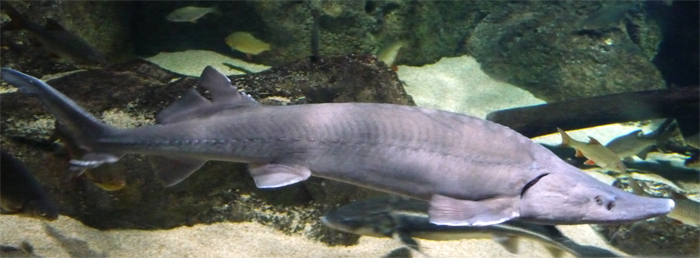
The Yenisei River is home to the Siberian sturgeon, Acipenser baerii, a species whose ancestors swam in the world's waters alongside dinosaurs. Fossil records for the sturgeon family date back to the Late Cretaceous period. One fossil found in North America is approximately 72 million years old. This lineage has survived for millions of years, retaining many of its ancient physical traits.
Instead of a bony skeleton, the Siberian sturgeon has a framework of cartilage, similar to sharks. Its body is not covered in scales but is protected by five rows of bony plates called scutes, which form a type of dermal armor. These fish are long-lived, with a lifespan of up to 60 years. They typically grow to about two meters (6.5 feet) in length and can weigh around 65 kg, though the maximum recorded weight for the species is 210 kg. The subspecies found in the Yenisei, Acipenser baerii stenorrhynchus, migrates long distances upriver from the Kara Sea to spawn.
A sixth sense for survival
To navigate the often dark and murky waters of the Yenisei, the Siberian sturgeon uses a specialized sensory system. Its snout is covered in a network of pores called the ampullae of Lorenzini. These organs are electroreceptors, filled with a conductive jelly, that can detect the minute electric fields produced by the muscle contractions of prey hidden on the riverbed. This "sixth sense" allows the sturgeon to hunt effectively without relying on sight.
Their diet consists mainly of benthic organisms, such as crustaceans, worms, insect larvae, and mollusks, which they suck up from the river bottom using their toothless, vacuum-like mouths. This feeding method is important for their survival in the nutrient-poor Siberian ecosystem.
The species faces significant threats. The IUCN Red List classifies the wild Siberian sturgeon as Critically Endangered. Dam construction has blocked access to more than 40% of their historical spawning grounds. Poaching for their roe, which produces black caviar, and industrial pollution have also caused severe population declines.