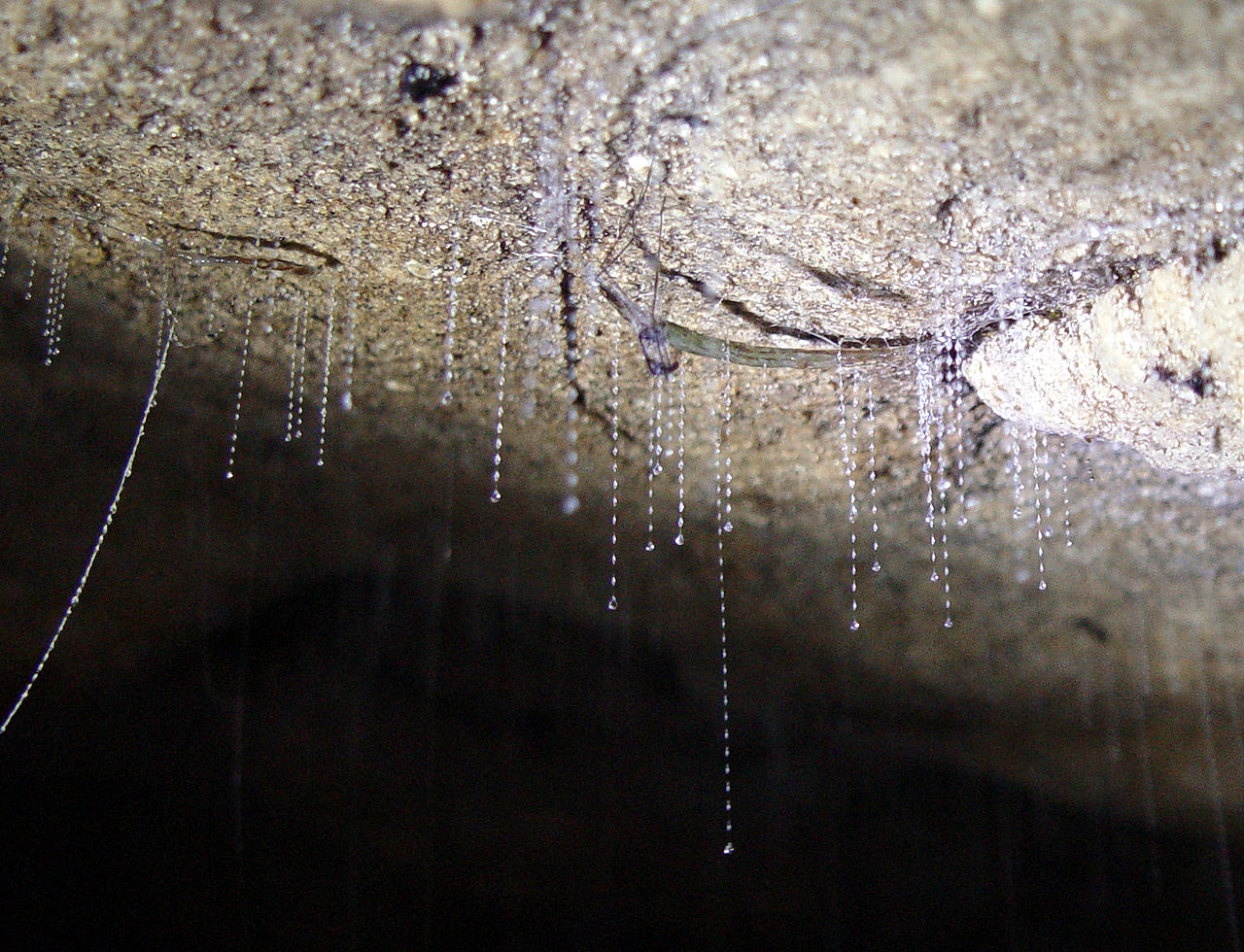
The larvae produce light through luciferin reactions to attract prey. Spectral analysis shows peak emission at 487nm, a wavelength that travels farthest in cave darkness.
Mnolf, CC BY-SA 3.0, via Wikimedia Commons
A chemical lantern
The famous blue-green glow of the New Zealand glowworm, Arachnocampa luminosa, is not a simple biological quirk; it is a precisely controlled chemical reaction. This "cold light" is a form of bioluminescence, generated when an enzyme called luciferase catalyzes the oxidation of a light-producing molecule, luciferin. This process, which also requires oxygen, magnesium ions, and the energy-carrying molecule adenosine triphosphate (ATP), releases energy almost entirely as light, with very little heat.
The entire chemical factory is housed within a specialized light organ at the posterior end of the larva. This organ is a modification of the Malpighian tubules, the insect equivalent of kidneys. The specific luciferin used by Arachnocampa luminosa is chemically distinct from the type used by fireflies, synthesized from xanthurenic acid and the amino acid tyrosine. While the luciferase enzyme belongs to the same protein family as that found in fireflies, they are not interchangeable; firefly luciferin will not react with glowworm luciferase, and vice versa. The intensity of the glow is directly related to hunger—a hungrier larva produces a brighter light to improve its chances of attracting a meal.
The optics of a sticky trap
The light's function is predation. The glowworm larva, which is the long-lived stage of a fungus gnat, constructs a silken nest and deploys an array of "fishing lines." These lines, which can be up to 40 cm long in still cave environments, are silk threads studded with droplets of sticky mucus. The light lures small flying insects, such as midges, which navigate toward the glow believing it to be an exit or the open sky. They become ensnared in the sticky threads.
The specific color of the light helps the trap's success. The peak emission occurs at a wavelength of 487 nanometers, which corresponds to a bright blue-green light. This wavelength travels with high efficiency through dark and damp environments and is highly visible to the photoreceptors of many insects. The sticky droplets on the fishing lines are not simple mucus; they are a hydroscopic substance designed to remain effective in the high humidity of the caves. Chemical analysis reveals the droplets are composed mainly of water, proteins, lipids, and urea. The urea is particularly important, as it actively draws moisture from the air, preventing the traps from drying out. When prey is caught, the larva ingests the thread to consume its meal.
💡Fun Facts
A hungry larva glows more brightly to attract more prey.
The adult fungus gnat has no mouthparts, cannot eat, and lives only a few days to reproduce.
The Māori name for the glowworm is "titiwai," which translates to "lights reflected in water."
The sticky substance on the fishing lines is made primarily of urea, the main component of urine.
The Waitomo Glowworm Caves are typically open daily from 9:00 AM to 5:00 PM, with extended hours during peak season. It is recommended to check the official website for the most current tour times.
Admission
Admission requires a ticket for a guided tour. Prices vary depending on the specific cave tour or combo package selected. Options range from the classic 45-minute boat tour to longer walking tours and black water rafting adventures.
Accessibility
The main Waitomo Glowworm Caves tour has some stairs. Ruakuri Cave, another cave in the area with glowworms, is wheelchair and stroller accessible.