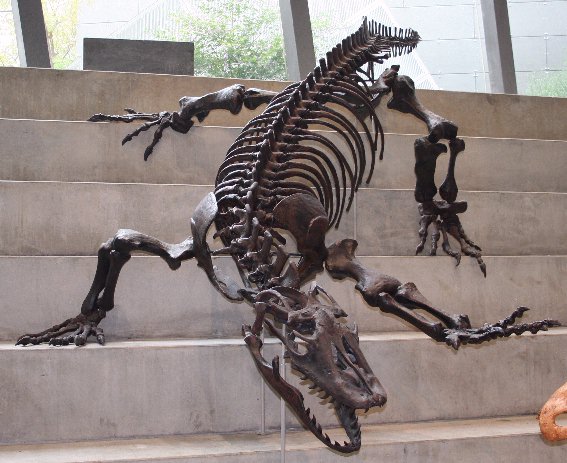
The Ancient Great Roamer
During the Pleistocene epoch, Australia was where Varanus priscus, the largest terrestrial lizard known to have existed. This giant monitor lizard, popularly known as Megalania, was the top predator in an ecosystem of megafauna. Fossil remains are fragmentary, making precise size estimates difficult, but studies suggest lengths of around 5.5 meters and weights of up to 575 kilograms. Some reconstructions based on vertebral scaling propose a maximum length of up to 7 meters. The first scientifically described remains were three vertebrae collected from the bed of a tributary of the Condamine River in Queensland. These were examined by Sir Richard Owen in 1859, who named the creature Megalania prisca, meaning "ancient great roamer." Later analysis showed its close relationship to modern monitor lizards, placing it within the same genus, Varanus.
Fossil evidence, primarily composed of vertebrae and teeth, is found across eastern and central Australia, from northern Queensland to South Australia. These remains indicate that Varanus priscus inhabited a range of environments including open forests, woodlands, and grasslands. Its heavy body, powerful limbs, and large skull with serrated blade-like teeth made it a hunter. It occupied a similar ecological niche to its closest living relative, the Komodo dragon, preying on medium to large animals. The diet of Varanus priscus likely included giant marsupials like Diprotodon, large birds, and other reptiles.