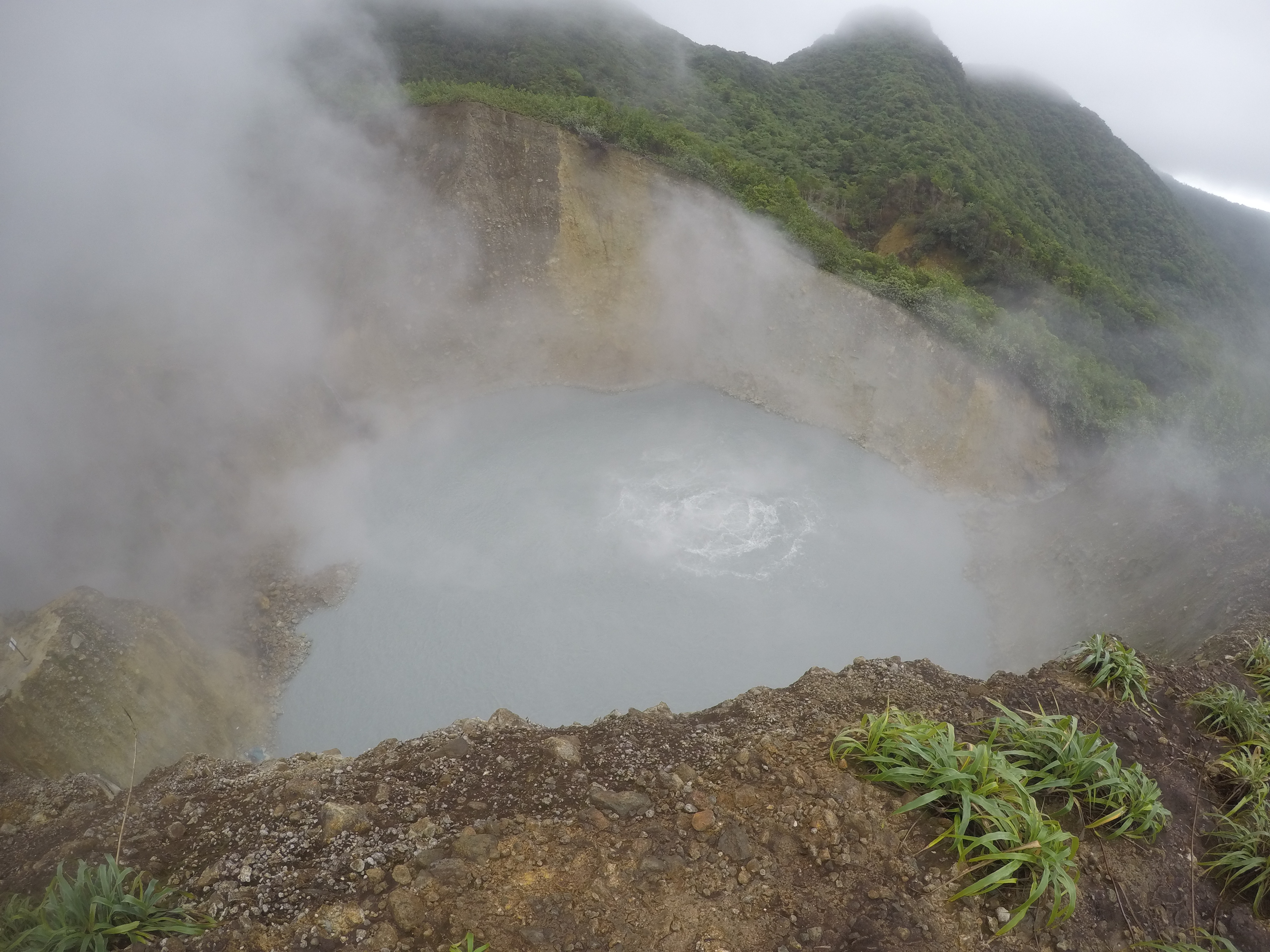
A volcanic valley with boiling lakes, fumaroles, and hot springs creates extreme temperature gradients. Thermophile communities exist within meters of tropical rainforest species.
Bayukjdr, CC BY-SA 4.0
A Geothermal Landscape
The Valley of Desolation is a volcanic amphitheater within Dominica's Morne Trois Pitons National Park, a UNESCO World Heritage Site. The area displays the Earth's subsurface heat, a result of the Atlantic tectonic plate subducting beneath the Caribbean plate at a rate of about 2 centimeters per year. This geological process fuels the island's nine active volcanic centers. The valley itself is a group of collapsed craters, characterized by intense geothermal activity.
Visitors encounter a landscape filled with hissing fumaroles, bubbling mud pots, and hot springs with temperatures that can exceed 100°C (212°F). The air is thick with a mix of water vapor, sulfur dioxide, and hydrogen sulfide, which produces a distinct "rotten egg" smell. These sulfurous gases create an acidic environment that inhibits most plant growth, leaving the ground barren unlike the surrounding rainforest. The ground is painted with mineral deposits, showing bright yellows from sulfur and oranges from iron oxides. The streams that flow through the valley are often a milky, grey-blue color due to suspended clay sediments and dissolved minerals like kaolinite. This active system has produced phreatic (steam-blast) eruptions, with documented events in 1880 and 1997.
Life at the Extremes
The scalding, acidic environment of the Valley of Desolation appears lifeless, but supports communities of extremophiles, specifically thermophiles that thrive in high temperatures. While the surrounding rainforest is dense with tropical vegetation, the ground inside the valley is too hot and chemically harsh for most plants. Yet, in the hot springs and streams, microbial life flourishes. Some pools are rimmed with green extremophilic algae, possibly from the genera Galdiera or Cyanidium. Sulfur-oxidizing bacteria are also present; they metabolize sulfur compounds and contribute to the production of iron monosulfide, which can turn the water a murky black color.
These microorganisms represent some of the most resilient life forms on the planet. Thermophiles, which include bacteria and another domain of single-celled life called archaea, function at temperatures that would destroy the cells of most other organisms. Their enzymes and cellular structures are uniquely adapted to heat. The existence of these thermophilic communities just meters from the cool, shaded biodiversity of the national park's elfin woodland and rainforests creates an ecological gradient. The boundary between a microbial, heat-driven ecosystem and a complex, temperate rainforest makes the Valley of Desolation a natural laboratory for studying how life adapts to extreme environmental pressures.
💡Fun Facts
The water in the valley's streams can be hot enough to cook an egg, a common demonstration by local guides.
The characteristic "rotten egg" smell comes from hydrogen sulfide gas released by fumaroles.
The valley is the gateway to Boiling Lake, the second-largest hot lake in the world, which is technically a flooded fumarole.
Small phreatic, or steam-blast, eruptions occurred here in 1880 and as recently as 1997.
The trail is accessible during daylight hours; it is recommended to start early in the morning for the full hike to Boiling Lake.
Admission
A site pass is required for entry into the national park's main attractions.
Accessibility
The terrain is extremely challenging, with steep, muddy slopes, river crossings, and unstable ground. It is a strenuous, multi-hour hike suitable only for physically fit individuals. A guide is strongly recommended.