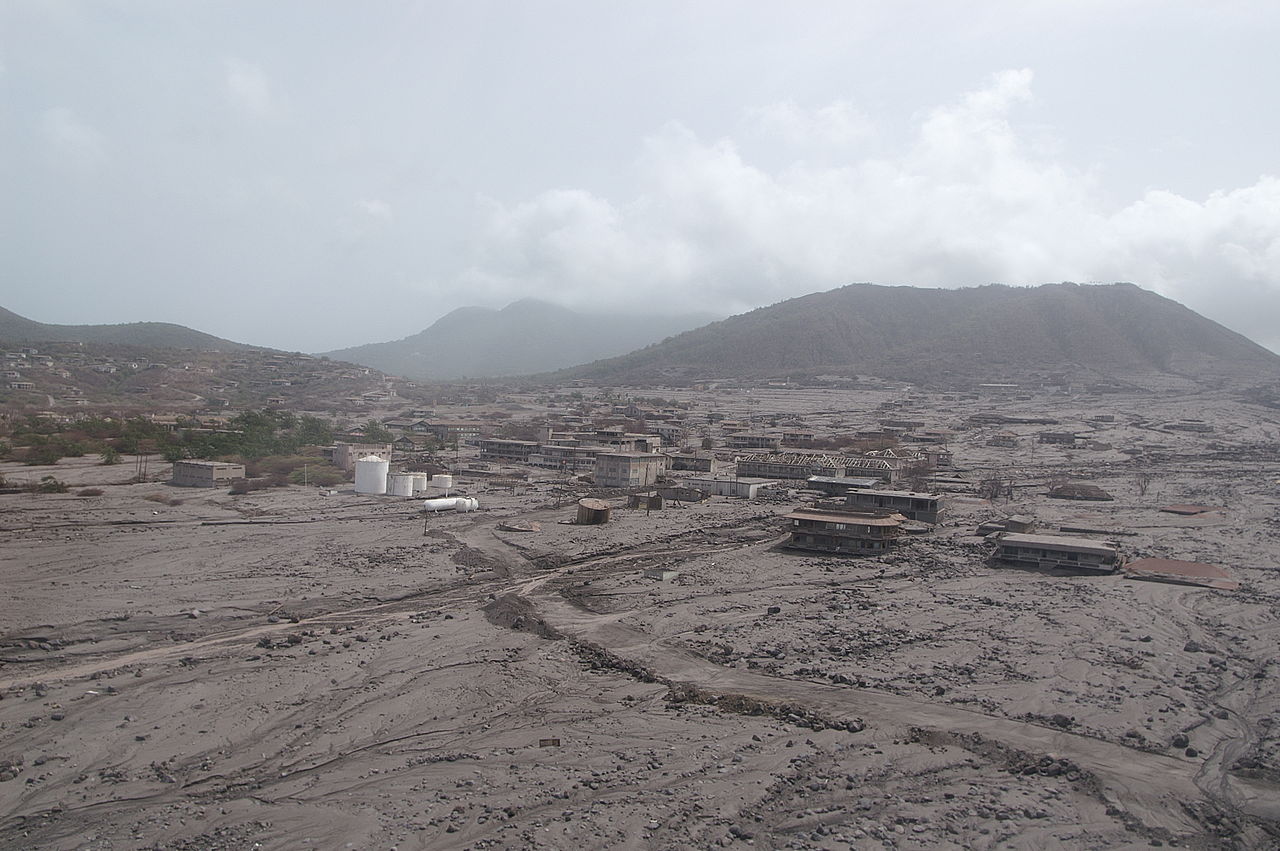
A volcano that buried a capital city in 1997. The dome grows and collapses in cycles scientists now use to predict eruptions worldwide.
Xb-70 at English Wikipedia, CC BY-SA 3.0, via Wikimedia Commons
A city erased
After centuries of dormancy, the Soufrière Hills volcano on the Caribbean island of Montserrat rumbled back to life on July 18, 1995. This stratovolcano produces a viscous andesitic lava that doesn't flow easily. Instead, it piles up over the volcanic vent, forming a steep-sided mound of hardened lava called a dome. For two years, this dome grew relentlessly.
On June 25, 1997, a major collapse of the lava dome occurred. This failure unleashed a pyroclastic flow—a superheated avalanche of gas, ash, and rock—down the volcano's northern flanks. These flows can reach temperatures of over 400°C (752°F) and travel at speeds exceeding 100 kph. The June 25th event sent about 8 million cubic meters of material crashing down the slopes in less than 20 minutes, killing 19 people who had returned to their homes within the evacuated zone. Through August of 1997, a series of further collapses sent pyroclastic flows directly into the capital city of Plymouth. The city was buried under more than 12 meters (39 feet) of volcanic debris, rendering it uninhabitable and forcing the permanent abandonment of the southern half of the island.
A predictable cycle
The destruction of Plymouth was a direct result of a process that volcanologists now study intensely: the cycle of lava dome growth and collapse. As viscous magma pushes toward the surface, the dome inflates and expands. This growth can be surprisingly rapid, with extrusion rates sometimes exceeding 40 cubic meters per second. As the dome grows larger—the biggest at Soufrière Hills reached a volume of over 200 million cubic meters—it becomes gravitationally unstable.
Eventually, parts of the dome give way, triggering the devastating pyroclastic flows. Following a major collapse, the pressure is released, often leading to explosive eruptions that can send ash columns 12,000 meters (40,000 feet) into the atmosphere. Scientists at the Montserrat Volcano Observatory (MVO) monitor these cycles with seismometers, GPS stations, and gas analyzers. They discovered that the volcano often enters a repetitive pattern of activity, with periods of dome growth followed by collapses and explosions at semi-regular intervals. This predictable rhythm at Soufrière Hills has provided a model for forecasting eruptions at similar dome-building volcanoes around the globe.
💡Fun Facts
The volcanic deposits from the eruption created new land, extending Montserrat's coastline.
Plymouth is the only capital city in the Americas that is a ghost town, completely abandoned and buried by volcanic activity.
The largest dome collapse, on Boxing Day 1997, triggered a small tsunami.
In September 1997, the volcano produced 75 distinct explosions over a 30-day period, occurring at a mean interval of 9.5 hours.
The Montserrat Volcano Observatory's viewing deck is open on weekdays. Documentary showings run hourly from 9:15 am to 3:15 pm. The southern part of the island, including Plymouth, is an exclusion zone with restricted access.
Admission
Visits to the MVO are free, but there is a small fee (EC$10/US$4) to watch the documentary.
Accessibility
The MVO viewing deck is accessible by car. Access to viewpoints for the exclusion zone requires a vehicle, and certified guides are recommended for tours.