A world before giants
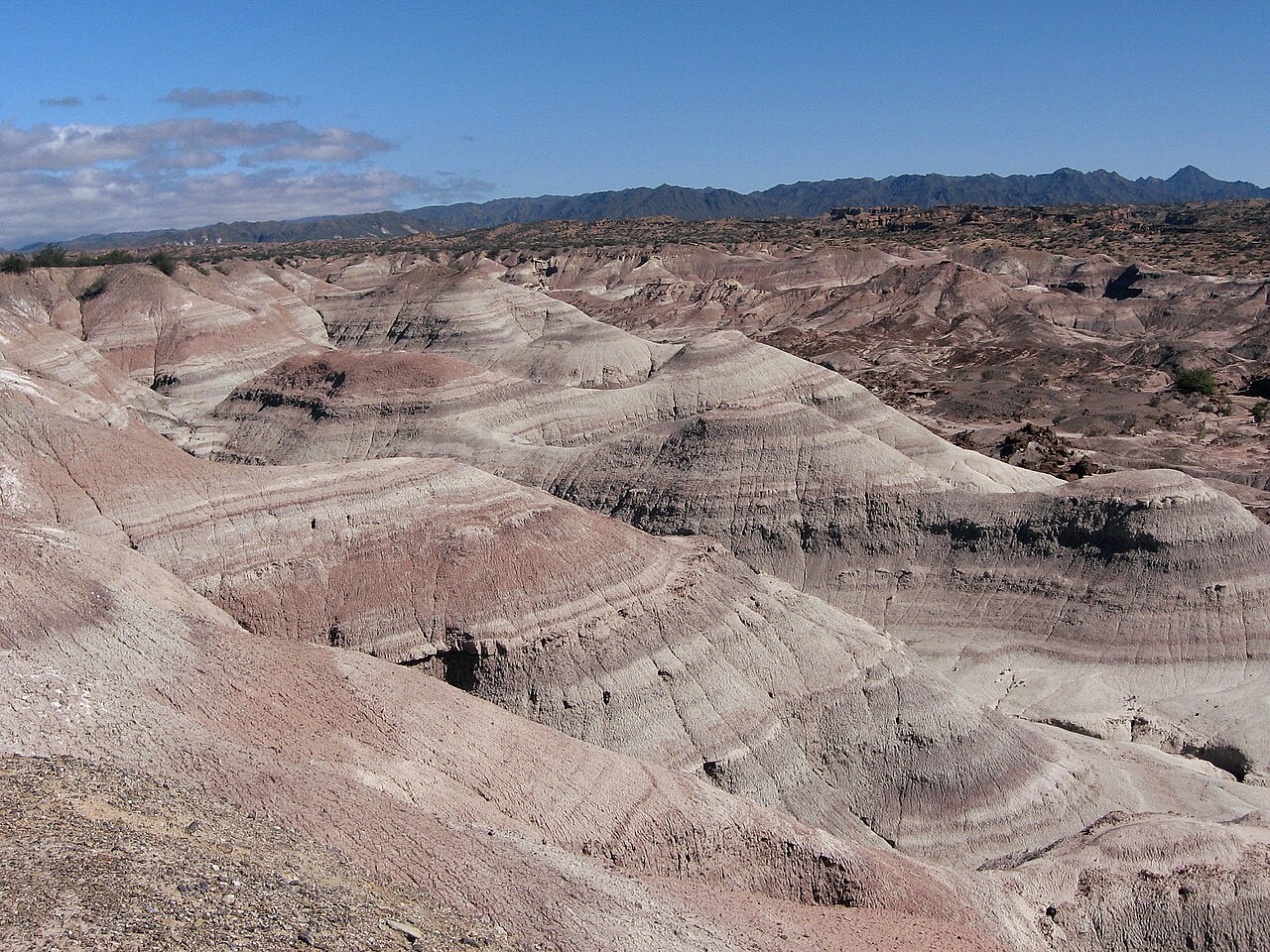
In the arid badlands of northwestern Argentina, the Ischigualasto Formation shows the Late Triassic period, a time between 231 and 225 million years ago. This geological layer, also known as the Valle de la Luna ("Valley of the Moon"), contains an almost continuous sequence of rock deposits that document a critical transition in Earth's history. During this era, the Carnian stage of the Triassic, the world was recovering from a mass extinction and new forms of life were emerging. The environment was a volcanically active floodplain with powerful seasonal rivers. This setting created the perfect conditions for preserving the remains of the animals that lived and died here, burying them in sediment before they could be scattered.
The rock layers at Ischigualasto Provincial Park preserve individual fossils, but a nearly complete paleo-ecosystem. The rock sequence overlies the Los Rastros Formation and is covered by the Los Colorados Formation, providing scientists with a timeline of environmental and biological changes. The fossil record is dominated by rhynchosaurs, like Hyperodapedon, and cynodonts, such as Exaeretodon. These plant-eating reptiles were the common prey animals of their time. Dinosaurs, at this point, were a minor part of the fauna, making up only about 6% of the total fossils found.
Rise of the first dinosaurs
Despite their rarity, the dinosaurs of Ischigualasto are some of the oldest and most primitive ever found. One of the most significant discoveries is Eoraptor lunensis, or "dawn plunderer from the Valley of the Moon." First found in 1991 by paleontologist Ricardo Martinez, Eoraptor was a small, bipedal animal, measuring only about one meter in length. Its teeth suggest it was an omnivore, capable of eating both plants and small animals. With five fully-developed fingers on its hands, it shows a more primitive form than later dinosaurs which often had reduced digits.
Sharing this environment was Herrerasaurus ischigualastensis, a larger and more formidable early dinosaur. Reaching up to 6 meters in length and weighing around 350 kilograms, it was one of the first large carnivorous dinosaurs. Its skull featured a flexible joint in the lower jaw, allowing it to hold struggling prey. Herrerasaurus was a swift bipedal runner with powerful hind limbs and sharp, curved claws for grasping. These two early dinosaurs show the anatomy and scale from which all later dinosaurs would evolve.
The top predator of the Ischigualasto ecosystem was not a dinosaur. It was Saurosuchus galilei, a massive pseudosuchian archosaur, a distant relative of modern crocodiles. This quadrupedal carnivore grew up to 7 meters long and was the apex predator of its time, likely preying on both herbivorous reptiles and early dinosaurs like Herrerasaurus. Analysis of its skull suggests that despite its size, its bite force was relatively weak—comparable to a modern gharial—indicating it may have fed on softer parts of carcasses rather than crushing bone. The presence of Saurosuchus shows that dinosaurs did not start at the top of the food chain; they rose to dominance only after these established predators went extinct.