Dawn of the dinosaurs
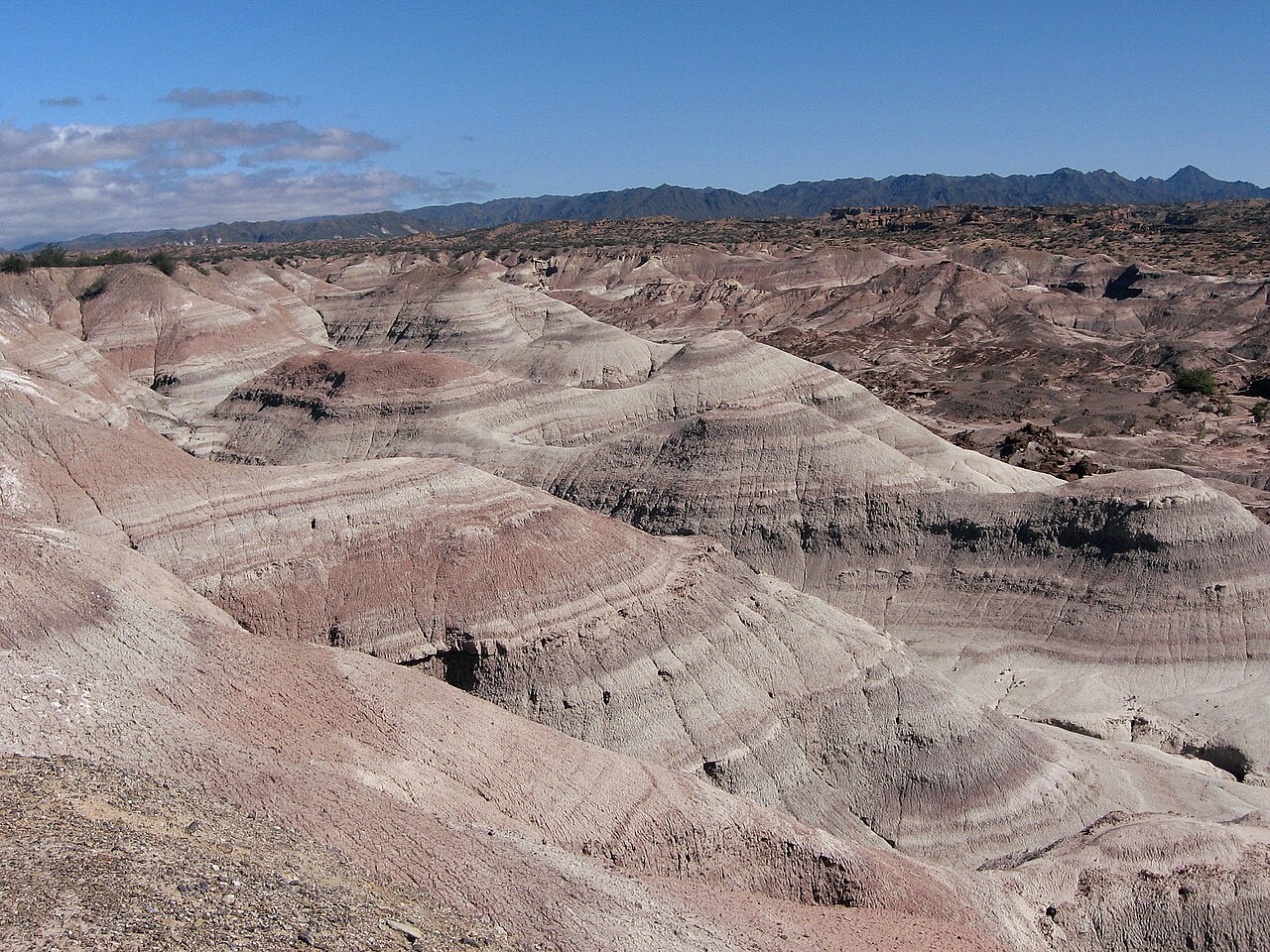
In the arid badlands of San Juan Province lies one of the most complete records of the Triassic Period on Earth. The sedimentary rocks of the Ischigualasto Formation, dating to the late Carnian stage around 231 to 225 million years ago, preserve a record of the dawn of the dinosaurs. At that time, this region was not a desert. It was a volcanically active floodplain with rivers and a dense vegetation of ferns, horsetails, and giant petrified conifers of the species Protojuniperoxylon ischigualastianus, some of which grew over 40 meters tall.
This ancient environment supported a diverse fauna, but was not dominated by dinosaurs. The most abundant fossils found here belong to herbivorous reptiles. These include the beaked rhynchosaurs, like Hyperodapedon, and large, mammal-like cynodonts such as Exaeretodon argentinus. Dinosaurs and their immediate relatives were a minor part of this ecosystem, represented by small, nimble animals. Among the most significant discoveries are some of the earliest known dinosaurs, including Eoraptor lunensis and Herrerasaurus ischigualastensis. Eoraptor was a lightly-built carnivore about one meter in length, a fraction of the size of its later relatives.
A world in transition
The Ischigualasto-Villa Unión Basin, which contains these fossil beds, provides an unparalleled sequence of continental strata documenting the Triassic. This record shows how life recovered and diversified after the Permian-Triassic extinction event, the largest mass extinction in Earth's history. The fossils here demonstrate that the rise of dinosaurs was gradual. For millions of years, they lived in the shadow of other animals. The abundance of cynodonts (the group that includes the ancestors of mammals) and pseudosuchians (crocodilian-line archosaurs) shows a complex world where multiple groups of animals competed.
The detailed fossil record allows paleontologists to trace the anatomical changes that defined dinosaurs. Skeletons like that of Herrerasaurus, a bipedal carnivore that reached up to 6 meters in length, show a mosaic of primitive and advanced features. The fossils found in this basin fill a critical gap in vertebrate evolution, documenting the period when dinosauromorphs began to radiate, leading to the 150-million-year reign of the dinosaurs. The entire area is now protected as a UNESCO World Heritage Site, preserving this unique chapter of planetary history.