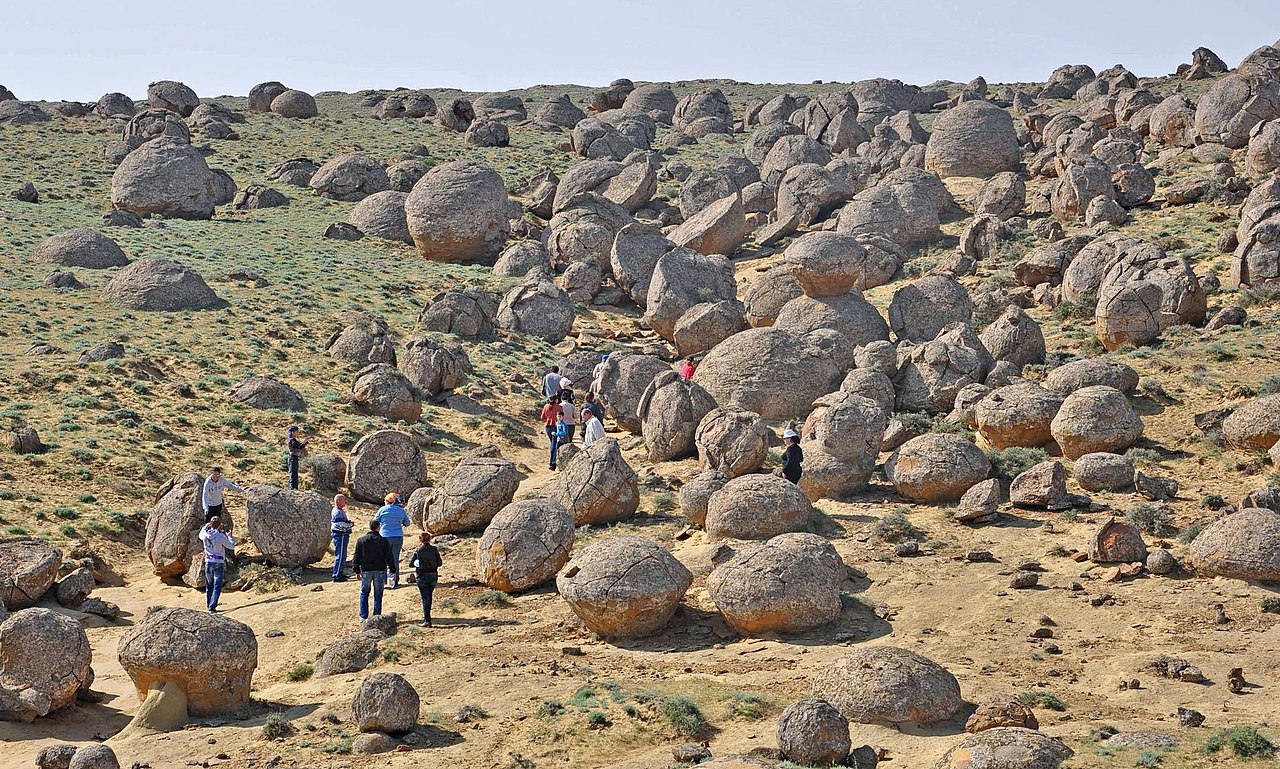
Perfectly spherical boulders up to 3 meters in diameter scattered across the desert. Formed by concretion growth around a nucleus grain over millions of years of chemical precipitation.
Alexandr Babkin, CC BY-SA 4.0, via Wikimedia Commons
A Valley of Natural Cannonballs
In the Mangystau Region of western Kazakhstan, the Ustyurt Plateau presents a strange and striking landscape known as Torysh, or the "Valley of Balls". Here, thousands of nearly perfect stone spheres are scattered across the steppe. These natural formations, known as spherical concretions, range in size from small marbles to enormous boulders reaching 3 to 4 meters in diameter. They are not rare globally, but the concentration and sheer size of the spheres at Torysh are exceptional. Many are almost perfectly round, while others are cracked, flattened or fused.
The plateau itself is a vast clay and stony desert of approximately 200,000 square kilometers, shared by Kazakhstan, Uzbekistan, and Turkmenistan. It is the former bottom of the ancient Tethys Ocean, which existed millions of years ago. The geological history of this region is important to the formation of the stone balls. What was once a seabed is now an arid plain, records deep geological time.
The Geology of Concretion
These stone balls are concretions, hard masses that form within sedimentary rock. The process began between 120 and 180 million years ago, during the Jurassic and Cretaceous periods, when the area was submerged under the Tethys Ocean. The formation starts with a nucleus; this could be a shell, a shark's tooth, a fossil, or any small, hard organic or inorganic particle..
Over millions of years, minerals in the water, such as calcite and silica, precipitated and cemented the surrounding sediment in concentric, onion-like layers around this central core. This process of mineral accumulation gradually builds the spherical shape. The concretionary cement is often harder and more resistant to weathering than the host rock. After the Tethys Ocean receded, millions of years of wind and water erosion wore away the softer surrounding sandstone and limestone, leaving the durable spherical concretions exposed on the surface. Some spheres are still partially embedded in the sedimentary layers from which they are slowly being released.
💡Fun Facts
The age of the concretions is estimated to be between 120 and 180 million years old, dating back to the time of the dinosaurs.
Local legends offer alternative explanations for the spheres, including one where they are petrified enemies turned to stone by local gods to protect the land.
The nucleus that starts the concretion process can be as small as a single grain of sand.
The Ustyurt Plateau also contains other geological wonders and archaeological sites, including ancient caravan routes from the Great Silk Road.
Open 24/7, accessible year-round, though spring (April-June) offers the most pleasant weather.
Admission
Free.
Accessibility
The site is remote and located in an open steppe with no infrastructure. Reaching the Valley of Balls requires a 4x4 vehicle, often as part of a guided tour from the city of Aktau (about 100km away) or the village of Shetpe (about 40km away). The final approach involves driving on dirt tracks.
Ustyurt Plateau stone ballsMangystau Region, Kazakhstan