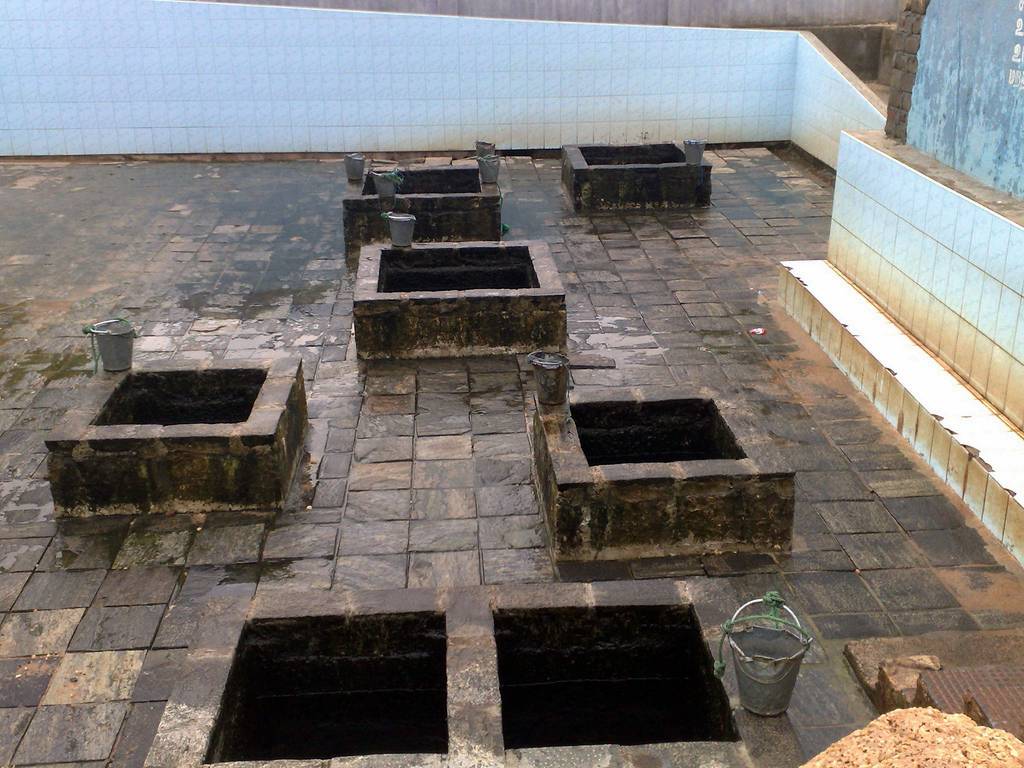
Wells of ancient water
The Kanniya Hot Springs are a set of seven square wells drawing water from deep within the Earth's crust. The surface water temperature in these wells varies, ranging from 30°C to 42°C. Each well is about one meter deep, and the bottoms are composed of sand and quartz gravel, which keeps the water clear. The wells can run dry after 10 to 15 buckets are drawn, refilling naturally over time.
The water's heat is not volcanic; it comes from the planet's natural geothermal gradient. The springs are located along the boundary of two major Precambrian geological units, the Highland and Vijayan complexes. Rainwater, known as meteoric water, percolates downward through deep fractures in this ancient rock. As it travels kilometers down, the water is heated by the surrounding rock at a rate of 20-60°C per kilometer. This heated, less dense water then rises back to the surface through these same fault systems. Magnetotelluric surveys suggest potential geothermal reservoirs at depths of 1.5 to 2 kilometers below the springs.
This deep-circulating water creates a unique habitat for life. The springs host thermophilic ("heat-loving") bacteria adapted to high temperatures. A 2023 study isolated a strain of Gram-positive rod-shaped bacteria from Kanniya capable of growing at 55°C. While the full microbial community is still under investigation, these organisms are of scientific interest for the thermostable enzymes they produce.
Myths and monasteries
Local legend, drawn from the Hindu epic Ramayana, attributes the springs' creation to King Ravana over 5,000 years ago. The story states that to perform the funeral rites for his mother, Ravana struck the ground seven times with his sword, and the hot springs emerged from those spots. For this reason, the site is considered sacred, and some Hindu families perform last rites for relatives here.
The site also has a long Buddhist history. Archaeological excavations have uncovered the ruins of a Buddhist monastery from the early Anuradhapura period (dating back to the 1st-2nd centuries A.D.). An inscription found on-site indicates that water from nearby tanks was reserved for the use of the resident monks. Today, the Department of Archaeology of Sri Lanka protects the seven wells and the surrounding ruins as an archaeological monument.
The water itself is chemically distinct. It is classified as weakly basic, with a pH ranging from 6.7 to 7.3. Unlike many geothermal springs, the water has low concentrations of sulfur. Chemical analysis shows it is high in bicarbonate (HCO3) and chloride (Cl) ions.