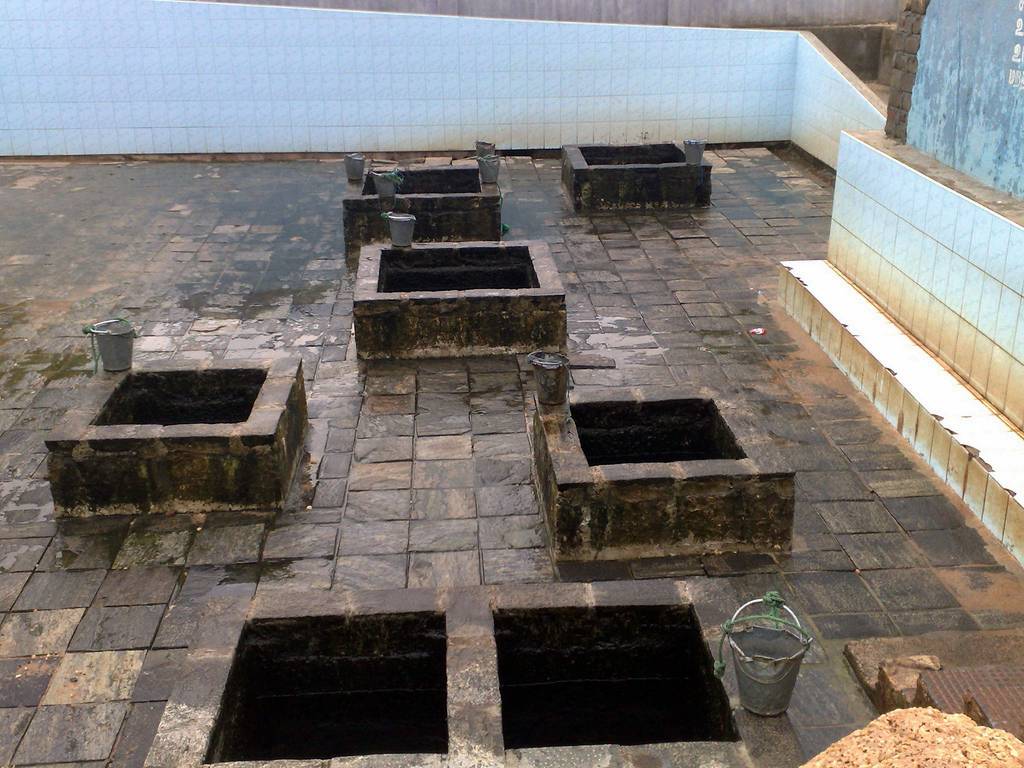
Seven hot wells of different temperatures rise within meters of each other. The chemistry suggests multiple fault-controlled flow paths bringing water from different depths.
K.shayanthan, CC BY-SA 4.0
A non-volcanic heat engine
The Kanniya Hot Springs emerge from a deep, non-volcanic plumbing system. Sri Lanka does not have active volcanoes, so the heat source is the planet's own geothermal gradient, the natural increase in temperature with depth. The springs are located along the boundary between two major Precambrian tectonic units, the Highland and Vijayan Complexes. This area is part of a 350-kilometer-long linear thermal anomaly that stretches from Hambantota to Trincomalee.
The process begins with rainwater, or meteoric water, which percolates downward through networks of faults and fractures in the ancient metamorphic rock. Models estimate this water circulates to a maximum depth of 3.5 to 5 kilometers into the Earth's crust. With a local geothermal gradient calculated at approximately 20-22°C per kilometer, the water heats to reservoir temperatures estimated between 140°C and 150°C. This superheated water becomes less dense and rises back to the surface through the same fault system, emerging as the Kanniya Hot Springs.
A chemical blueprint from below
The seven square wells at Kanniya are each about one meter deep and present a puzzle: their water temperatures vary, with measurements ranging from 39°C to 62°C. This variation occurs despite their close proximity. The reason is the final stage of the water's ascent. As the deep, hot water nears the surface, it mixes with shallow, cooler groundwater. The differing temperatures of the wells suggest several distinct flow paths, each with a different mixing ratio.
Chemical analysis of the water shows the history of its movement. The water is weakly basic to neutral, with a pH ranging between 6.7 and 7.3. Its electrical conductivity is low, between 288 and 428 μS/cm, which corresponds to a moderate level of total dissolved solids. The water is classified as a bicarbonate-dominant type, with elevated concentrations of HCO₃⁻ ions. Trace metal content is very low; analyses show iron levels below 0.09 mg/L and arsenic below 0.025 mg/L. Critically, stable isotope analysis of its oxygen and hydrogen composition confirms a meteoric origin, ruling out any significant input from magmatic sources.
💡Fun Facts
While the surface water is hot, the deep geothermal reservoir from which it originates is estimated to reach temperatures of 140–150°C.
The springs are located within the grounds of a former Buddhist monastery dating to the Anuradhapura Period, and a 2nd-century inscription found here mentions water taxes.
The surrounding rocks are part of a Precambrian continental fragment, meaning they are over 541 million years old.
According to a local Hindu legend from the Ramayana, the god Ravana created the springs by striking the ground seven times with his sword.
The entrance fee for foreign visitors is 50 Sri Lankan Rupees.
Accessibility
The site has a main car park, from which visitors walk a short distance through a market area to reach the wells. The wells themselves are in a paved courtyard.
Kanniya Hot Springs GeochemistryEastern Province, Sri Lanka