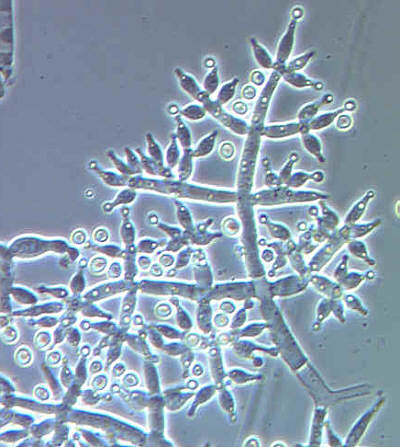
A genus of fungi that parasitizes other fungi by coiling around them and secreting enzymes that dissolve their cell walls. Widely used in agriculture as biological control against plant pathogens, they also produce antibiotics and growth-promoting compounds.
Public domain, via Wikimedia Commons
The Soil's Microscopic Predator
Beneath the surface of nearly every soil on Earth, a microscopic drama of predation unfolds. The main actor is Trichoderma, a genus of fungi with over 400 identified species that acts as a parasite of other fungi. This process, known as mycoparasitism, is a main reason Trichoderma is effective in agricultural biocontrol. The attack begins when a Trichoderma hypha (a fungal filament) detects chemical signals from a potential host, such as common plant pathogens like Rhizoctonia, Fusarium, or Pythium. The Trichoderma then grows directly toward its target.
Upon making contact, the Trichoderma hyphae coil tightly around the pathogen's filaments, sometimes forming appressoria—specialized penetration structures. This physical assault is followed by a chemical one. Trichoderma secretes a cocktail of cell wall-degrading enzymes, including chitinases and β-1,3-glucanases. These enzymes break down the chitin and glucans that form the structural integrity of the target fungus's cell walls, effectively dissolving them. Once the cell wall is breached, Trichoderma can access and consume the internal contents of the pathogen, killing it.
An Ally to Agriculture
The predatory nature of Trichoderma makes it a valuable tool for farmers seeking alternatives to chemical fungicides. More than 60% of registered biofungicides are based on Trichoderma formulations. Species like T. harzianum, T. viride, and T. asperellum are among the most commonly used. Their application helps manage a wide range of diseases, including root rot, damping-off, and wilts.
The benefits include more than killing harmful fungi. Trichoderma also enhances plant health through several other mechanisms. It can trigger Induced Systemic Resistance (ISR) in plants, which is similar to a vaccination. By colonizing the roots, the fungus primes the plant's defense systems, allowing it to respond more quickly and strongly to future pathogen attacks on its leaves and stems. This response involves signaling pathways dependent on plant hormones like jasmonic acid and ethylene.
Furthermore, many Trichoderma strains actively promote plant growth. They produce and secrete compounds like indole-3-acetic acid (IAA), a type of auxin, which is an important plant growth hormone. These compounds stimulate root development, leading to larger root systems that are more efficient at absorbing water and nutrients. Some strains can also solubilize phosphate in the soil, making this essential nutrient more available to the plant. Some species can even live as endophytes, residing inside plant tissues without causing harm and providing continuous benefits.
A Microscopic Factory
In addition to agricultural uses, Trichoderma is a producer of enzymes and secondary metabolites for various industries. The same cellulase enzymes it uses to break down plant matter in the soil are harnessed for commercial applications. Trichoderma reesei is a particularly effective producer of cellulases, which are used in the textile industry to create the "stone-washed" look on jeans by softening the fabric. These enzymes are also critical in the production of biofuels, where they break down cellulose from plant biomass into fermentable sugars.
The genus is also a rich source of antibiotics. It produces over 370 different secondary metabolites, many with antagonistic properties. These include compounds from a class called peptaibols, which can inhibit the growth of other fungi and some bacteria. This production of antimicrobial compounds is chemical warfare called antibiosis, giving Trichoderma another competitive edge in the complex soil ecosystem.
💡Fun Facts
Some *Trichoderma* species are endophytic, meaning they can live inside plant tissues without causing any disease.
The powerful cellulase enzymes produced by *Trichoderma reesei* are used in the textile industry to give denim its soft, "stone-washed" appearance.
The characteristic green color of many *Trichoderma* colonies comes from the pigment of their asexual spores, called conidia.
Some strains of *Trichoderma* can produce phytohormones like auxins, which directly stimulate plant root growth.