A blueprint in the body
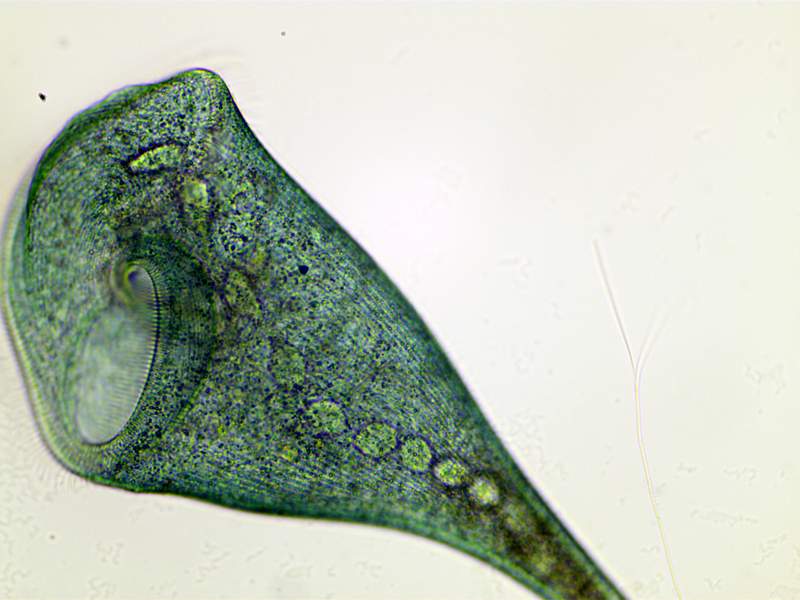
In freshwater ponds and lakes worldwide lives a single-celled organism that challenges fundamental ideas about biological form. Stentor coeruleus, a protist shaped like a trumpet, can grow up to 2 millimeters long, making it one of the largest known unicellular organisms and visible to the naked eye. Its complex structure includes a mouth surrounded by cilia, a posterior "holdfast" for anchoring, and a long, beaded macronucleus that stretches the length of its body. This ciliate is known for its remarkable ability to regenerate. If cut into pieces, any fragment containing just a small piece of the macronucleus can regrow into a complete, proportionally correct organism within hours.
This regenerative power is extreme; experiments have shown that fragments as small as 1/100th of the original cell's volume can successfully form a new, miniature Stentor. The process relies on the cell's highly polyploid macronucleus, which contains many copies of the entire genome. Even a small fraction of this nucleus holds all the necessary genetic information. The regeneration of a posterior fragment, which lacks the mouth, involves the formation of thousands of new basal bodies—structures that anchor cilia. These organize into rows, sprout cilia, and form a new oral apparatus that migrates to the correct anterior position. This process suggests that positional information for the body plan is in the DNA, but is somehow encoded in the cell's physical structure, a concept known as cortical inheritance.
The science of cellular memory
Stentor's regenerative ability makes it a model organism for studying how cells establish and maintain their shape without direct instructions from neighboring cells. When a Stentor is bisected, the front half regrows a tail, and the back half regrows a head, a process that takes about eight to ten hours. Researchers observe that the cell uses existing cellular structures, like the pattern of stripes on its surface, as guides for where to build new components. This indicates a form of "cellular memory" is stored within the cell's cortex. The process appears to redeploy some of the same genetic programs and molecular machinery used during normal cell division.
The organism's distinct blue-green color comes from a pigment called stentorin, which is located in granules between the stripes on its surface. Stentorin acts as a photoreceptor, allowing the cell to sense and react to light, typically by contracting or swimming away from a sudden bright source. This behavior, combined with its regenerative capacity, shows a high degree of complexity in a single cell. By studying how genes are activated during regeneration, scientists can identify the molecular components responsible for organizing the cell's architecture, showing the fundamental principles of morphogenesis that could apply across biology.