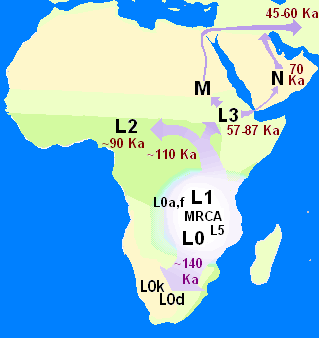
The calculation that found 'Eve'
In a laboratory at the University of California, Berkeley, three scientists changed our understanding of human origins. In 1987, Rebecca Cann, Mark Stoneking, and Allan Wilson published "Mitochondrial DNA and Human Evolution" in the journal Nature. Their research proposed that all living humans could trace their maternal lineage back to a single woman who lived in Africa approximately 200,000 years ago. This common ancestor was later nicknamed 'Mitochondrial Eve'.
The team's work centered on mitochondrial DNA (mtDNA), a small circular genome of 16,569 base pairs found inside the mitochondria of our cells. Unlike nuclear DNA, which is a mix from both parents, mtDNA is passed down almost exclusively from mother to child. This direct, maternal inheritance provides a clearer line to trace ancestry. The researchers hypothesized that by comparing the mutations in mtDNA from people around the world, they could create a family tree and calculate how long it would take to trace all the branches back to a single root. This concept uses the mutation rate of DNA as a "molecular clock".
They analyzed mtDNA samples from 147 individuals representing five distinct geographic populations: Africa, Asia, Europe, Australia, and New Guinea. The samples were primarily obtained from placentas. The analysis showed that the African DNA samples had the most diversity, implying they were the oldest lineages. All non-African populations appeared to be descendants of a branch that split off from the African tree. Their calculations, assuming a mutation rate of 2%-4% per million years, pointed to a common ancestor who lived between 140,000 and 290,000 years ago.
A new chapter in human evolution
The paper, submitted in 1985 and finally published after more than 40 revisions on January 1, 1987, strongly supported the "Out of Africa" model of human evolution. This model proposes that modern humans originated in Africa and then migrated, replacing older human populations elsewhere. The work of Wilson's lab provided powerful genetic evidence for a recent, African origin for all modern humans.
Understand what "Mitochondrial Eve" means. She was not the first human woman, nor was she the only woman alive at the time. Many other women lived during her era and have descendants today. However, their direct maternal lines have ended at some point. Eve is simply the most recent woman from whom all living humans descend in an unbroken female line. It is a concept of coalescence, a point in the past where all current lineages converge.
The original study faced criticism, particularly regarding its computer-based methods for constructing the evolutionary tree. However, the fundamental conclusion has been supported by decades of subsequent research. While the exact date has been refined by various studies, most modern estimates place Mitochondrial Eve's existence between 99,000 and 200,000 years ago, consistent with the 1987 paper's findings. The work done here, in Allan Wilson's Berkeley lab, is a foundational event in the field of molecular anthropology.