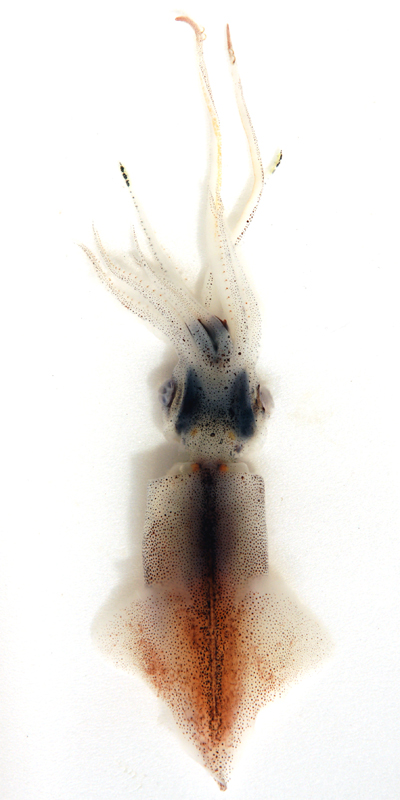
The daily commute of a glowing squid
Each day, millions of firefly squid (Watasenia scintillans) perform a vertical migration in the waters of Toyama Bay. By day, these small cephalopods, which grow to only about 7.5 centimeters, live at depths between 200 and 600 meters. As night falls, they ascend to the upper 20 to 60 meters of the water column to hunt. This daily migration is known as diel vertical migration.
This predictable movement is possible because of Toyama Bay's unusual underwater geography. The bay floor drops off steeply into a deep submarine canyon system that extends 750 kilometers. This feature brings deep-sea habitats unusually close to the coastline, allowing these deep-dwelling squid to be found near the shore during their nightly ascent. The bay has 500 of the 800 marine species found in the Sea of Japan, sustained by nutrient-rich freshwater from seven rivers that flow from the surrounding 3,000-meter-high mountains.
The firefly squid's migration is driven by both feeding and reproduction. They feed on copepods, small fish, and other crustaceans near the surface at night. This cycle culminates in a massive spawning event between March and May each year, which is the final act of their one-year lifespan. After mating and laying their eggs, the adult squid die.
Camouflage by counter-illumination
The firefly squid's most important feature is its ability to produce light, or bioluminescence. This light is generated by a chemical reaction between a compound called luciferin and an enzyme, luciferase, within specialized light-producing organs called photophores. Hundreds of these photophores dot the squid's underside, with larger ones located around its eyes and on the tips of its fourth pair of arms.
This bioluminescence is important to the squid's primary defense mechanism: counter-illumination. When viewed from below by a predator, any creature in the mid-ocean depths will appear as a dark silhouette against the faint light filtering down from the surface. The firefly squid actively cancels out its own shadow by emitting blue light from its belly. It can precisely match the color and intensity of the ambient light from above, effectively becoming invisible to predators like northern fur seals and larger fish lurking below. This active camouflage is a form of crypsis used by many mid-water marine organisms. The squid can also flash its lights brightly to startle an attacker before making a quick escape.