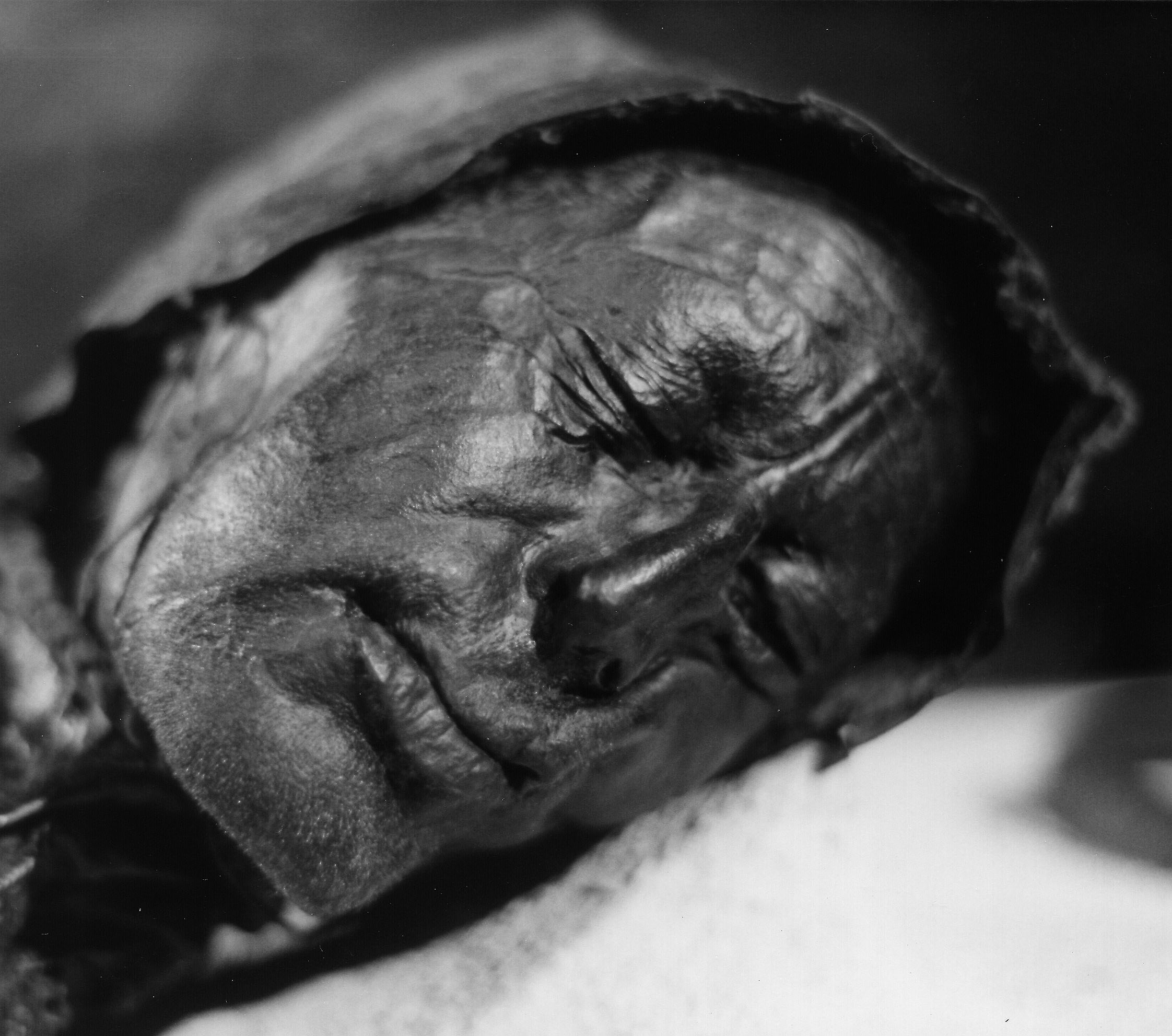
His 2,400-year-old face is so well preserved you can see wrinkles. Stomach contents reveal his last meal was porridge, eaten 12-24 hours before ritualistic hanging.
Sven Rosborn, Public domain
An Accidental Discovery
On May 6, 1950, two brothers cutting peat for fuel in the Bjældskovdal bog near Silkeborg, Denmark, uncovered a face in the dark earth. The man's features were so intact—complete with fine wrinkles, short-cropped hair, and a day's worth of stubble—they believed they had found a recent murder victim and immediately called the police. An investigation soon revealed the man was not a modern homicide case; he was an archaeological specimen from the Pre-Roman Iron Age. Radiocarbon dating indicates he died between 405 and 380 BCE.
The man, now known as the Tollund Man, was found lying on his side in a fetal position, as if sleeping. He was naked except for a pointed sheepskin cap fastened under his chin and a hide belt around his waist. A plaited leather rope was wrapped tightly around his neck, revealing his cause of death. Forensic analysis shows his cervical vertebrae were undamaged, meaning he died from asphyxiation and not a snapped neck. This, combined with the careful placement of his body, suggests a ritual sacrifice and not a common execution. At the time of his death, he was approximately 40 years old and stood about 161 cm (5 ft 3 in) tall.
The Chemistry of Preservation
The Tollund Man’s remarkable preservation is a result of the unique chemistry of peat bogs. These environments are cold, low in oxygen, and highly acidic. The main preserving agent is a type of moss called Sphagnum, which carpets the bog. As the moss dies, it releases a carbohydrate polymer called sphagnan. This substance inhibits bacterial growth and effectively tans the skin and soft tissues, turning them a leathery brown. While the skin, hair, and internal organs are exceptionally preserved, the acidic water often dissolves the calcium phosphate in bones, leaving them soft and demineralized.
This natural mummification process preserved the contents of the Tollund Man's digestive tract for over two millennia. A 2021 re-analysis of his gut provided a detailed recipe of his last meal, consumed 12 to 24 hours before he died. It was a porridge made of about 85% barley, 9% pale persicaria (a common weed), and 5% flax. Protein analysis also detected the presence of a bony fish. The meal also contained threshing waste—seeds and chaff normally removed from grain—which may suggest it was prepared for a special, ritual occasion. He was also infected with several types of parasitic worms, likely from eating undercooked meat or drinking contaminated water during his life.
💡Fun Facts
His fingerprints and footsole patterns are as clear as those of a modern person.
Only the head of the Tollund Man is original; the body is a replica reconstructed in 1987 after the original body deteriorated due to the conservation methods of the 1950s.
Twelve years before his discovery, another bog body from a similar time period, the Elling Woman, was found just 50 meters away in the same bog.
Analysis of his 1-millimeter-long stubble suggests he had not shaved on the day he died.