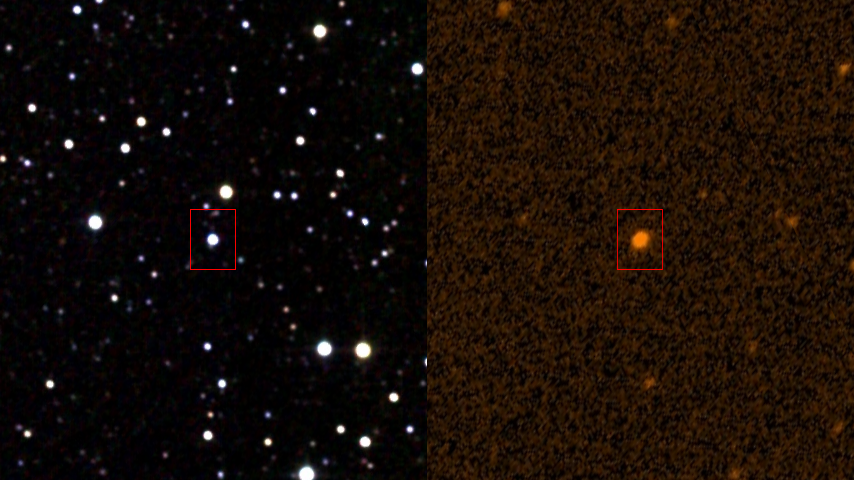
A flickering cosmic mystery
In the constellation Cygnus, approximately 1,470 light-years from Earth, lies a star called KIC 8462852. It is an F-type main-sequence star, slightly larger and hotter than our Sun. For years, it was one of over 150,000 stars monitored by NASA's Kepler space telescope. Kepler's mission was to detect the tiny, periodic dips in a star's brightness caused by a transiting exoplanet, which typically block 1% or less of the light.
In 2015, citizen scientists working on the Planet Hunters project flagged KIC 8462852's light curve as bizarre. Instead of small, regular dips, the star showed immense, erratic drops in brightness. Data collected between 2009 and 2013 revealed multiple dimming events, one reducing the star's light by 15% and another by a staggering 22%. These events were aperiodic, lasting for days at a time, and had complex, asymmetrical shapes. No planetary system or stellar phenomenon could readily explain this behavior.
Studies of historical photographic plates suggested the star had also been gradually fading for a century, dimming by as much as 20% between 1890 and 1990. Analysis of the four years of Kepler data confirmed a more recent, rapid dimming trend, independent of the sharp, day-long dips. The star dimmed by about 0.34% per year for three years, then the rate increased to 2.5% over a 200-day period.
From megastructures to dust
The light curve invited a range of explanations. One hypotheses was that the dimming was caused by an "alien megastructure." This idea, often linked to the concept of a Dyson swarm, suggests a vast collection of orbiting structures built by an advanced civilization to harvest the star's energy. Such a swarm could theoretically create irregular and substantial blockages of starlight. The SETI Institute even used the Allen Telescope Array to listen for radio signals from the star, but detected none.
Conventional scientific explanations focus on natural phenomena, though each faces challenges. A leading theory proposes a massive swarm of exocomets or planetary debris on an eccentric orbit. However, the sheer quantity of material required to block 22% of the star's light presents a problem for this model. Other ideas include the aftermath of a planetary collision or the breakup of an orphaned exomoon.
Current evidence points toward an uneven cloud of circumstellar dust. Observations from NASA's Spitzer and Swift missions showed that the dimming is wavelength-dependent, more blue and ultraviolet light is blocked than red and infrared light. A solid object, like a planet or a megastructure, would block all wavelengths of light equally. This pattern is characteristic of fine dust particles, smaller than a micrometer in diameter. This finding strongly argues against the megastructure hypothesis, but the origin of such a persistent dust cloud around a mature star remains an unsolved puzzle.