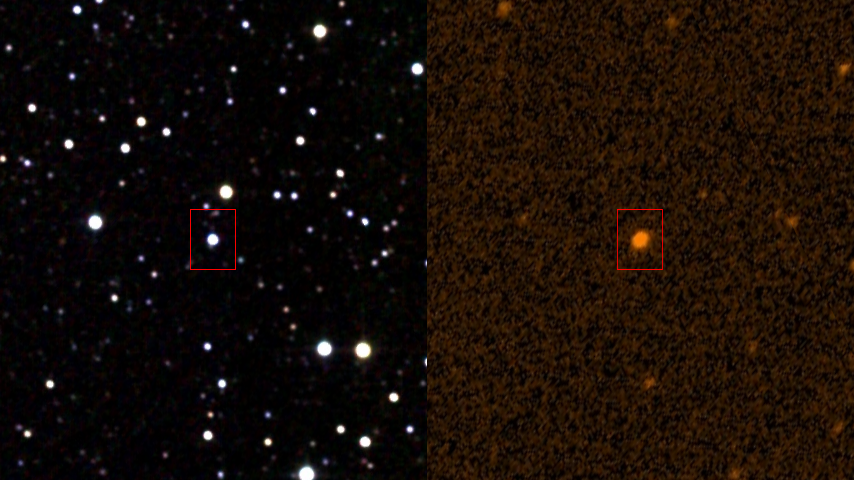
A star showing bizarre dimming patterns suggesting a massive megastructure. Natural explanations involve unprecedented comet swarms.
Infrared: IPAC/NASA Ultraviolet: STScI (NASA), Public domain, via Wikimedia Commons
A mysterious stellar anomaly
In the constellation Cygnus, approximately 1,470 light-years from Earth, lies a star cataloged as KIC 8462852. It is an F-type main-sequence star, slightly larger and hotter than our Sun. For most of its existence, it was an anonymous point of light among hundreds of thousands monitored by NASA's Kepler Space Telescope. That changed when citizen scientists in the Planet Hunters project flagged the star for its extraordinary behavior.
Between 2009 and 2013, Kepler recorded the star's brightness, looking for the tell-tale, periodic dips that indicate an orbiting planet. KIC 8462852, however, showed something entirely different. It exhibited deep, non-periodic dips in brightness that lasted for days or weeks. The dimming events were irregular in their timing and duration. Most remarkably, the amount of blocked light was immense. While a Jupiter-sized planet might block about 1% of a star's light, this object caused dips of up to 22%. This was far too substantial to be an ordinary planet. The star became known as "Tabby's Star" or "Boyajian's Star," after Tabetha S. Boyajian, the astronomer who led the initial investigation.
Competing scientific explanations
The bizarre light curve of KIC 8462852 demanded an explanation, and scientists proposed several hypotheses. The most sensational idea, suggested by astronomer Jason Wright, was the possibility of an alien "megastructure." This concept, often called a Dyson swarm, involves a vast array of orbiting structures built by an advanced civilization to harvest a star's energy. Such a large, irregularly shaped cluster of objects could, in theory, produce the observed light dips. The SETI Institute even used the Allen Telescope Array to listen for radio signals from the star, but found none.
Most scientists favor natural explanations, though none perfectly fit all the data. One leading theory involves a massive swarm of disintegrating comets. The gravitational pull of a nearby M-type red dwarf, a stellar companion to Tabby's Star, could have perturbed comets from an Oort-like cloud, sending them toward the star where they would break apart and release vast clouds of gas and dust. Another model suggests the star may have consumed a planet, leaving orbiting debris.
Recent data provides strong evidence for circumstellar dust. Observations show that different wavelengths of light are blocked by different amounts—ultraviolet light dims more than infrared light. This indicates fine dust particles, as an opaque object such as a planet or a megastructure would block all wavelengths of light equally. While this suggests dust is the direct cause, the origin of such an enormous and unevenly distributed dust cloud around a mature star is still unknown.
💡Fun Facts
The star is nicknamed "Tabby's Star" after astronomer Tabetha S. Boyajian, the lead author of the first scientific paper on its strange behavior.
The anomaly was first discovered by volunteers in the Planet Hunters citizen science program, who were tasked with looking for transiting exoplanets in Kepler data.
The largest recorded dip in brightness blocked 22% of the star's light, an amount far too large to be caused by a single orbiting planet.
Analysis of historical photographic plates suggests the star may have also faded by as much as 20% between 1890 and 1989.