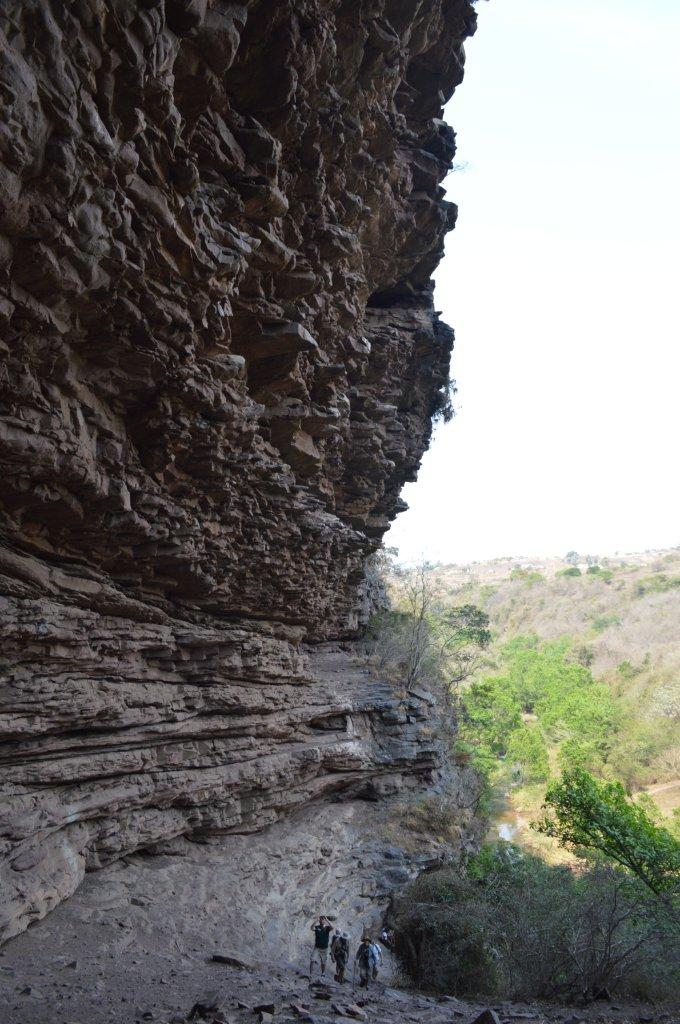
77,000-year-old grass bedding layered with leaves from plants that repel mosquitoes and ticks - proof that Stone Age people understood pharmacology. They periodically burned the bedding, likely to eliminate parasites. Pest control is 77,000 years old.
DarkaRolandStark, CC BY-SA 3.0, via Wikimedia Commons
The world's oldest engineered living surface
In Sibudu Cave, a rock shelter above the uThongathi River, archaeologists have uncovered the earliest evidence of humans deliberately constructing a clean and pest-free living area. Dating back 77,000 years, these are the oldest known "beds" ever discovered. The findings consist of multiple, compressed layers of plant matter, some just a centimeter thick after millennia of compression. These layers covered areas of up to three square meters on the cave floor.
The bedding was a composite material, constructed with a specific purpose. The base layer consisted of various sedges, rushes, and other monocotyledons gathered from the nearby riverbank. This provided a cushioned surface for living and working. At least 15 distinct bedding layers have been identified at the site, with occupations spanning from 77,000 to 38,000 years ago, showing that humans repeatedly returned to and maintained this space. The dating of the layers was accomplished using optically stimulated luminescence (OSL) on quartz grains within the sediment. This work has helped establish a detailed timeline of the cave's occupation during the Middle Stone Age.
A Stone Age pharmacy
The most remarkable feature of the Sibudu bedding is its top layer. On top of the sedge mattress, the cave's Homo sapiens inhabitants placed a thin sheet of leaves from the River Wild-quince, Cryptocarya woodii. This was no random choice. The leaves of this tree, also known as Cape laurel, are aromatic and contain potent chemical compounds with known insecticidal and larvicidal properties. Chemical analysis shows the leaves contain α-pyrones, cryptofolione, and goniothalamin, which are effective repellents against pests like mosquitoes.
This selection shows a sophisticated understanding of plant properties. The inhabitants of Sibudu were practicing a form of pharmacology to make their living space healthier and more comfortable, likely protecting themselves from vector-borne diseases like malaria. Further evidence of sanitation practices appears in the archaeological record around 73,000 years ago, when the inhabitants began to systematically burn the old bedding. This controlled use of fire would have destroyed pests and their eggs, cleaning the site for the next occupation. These combined practices—medicinal plants and regular burning—are a complex system of site maintenance previously unknown for this time period.
💡Fun Facts
The Sibudu bedding is 50,000 years older than any other bedding previously discovered.
The main medicinal plant, *Cryptocarya woodii*, is still used in traditional medicine today.
The cave has also yielded the earliest known bone needle (61,000 years old) and some of the earliest evidence for bow and arrow technology (64,000 years old).
Sibudu Cave was declared a UNESCO World Heritage Site in 2024 as part of a collection of sites showing the emergence of modern human behavior.
The site is an active archaeological excavation and is not open to the general public.
Admission
Not applicable.
Accessibility
The cave is located on a steep, forested cliff overlooking the uThongathi River and would require crossing the river to access, making it difficult to reach. Artifacts and exhibits may be viewed at the KwaZulu-Natal Museum.