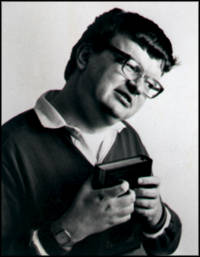
Brain damage can suddenly unlock extraordinary mathematical, artistic or memory abilities. What latent capabilities exist and why they're locked remains unknown.
Attribution, via Wikimedia Commons
The island of genius
Savant syndrome is a condition where individuals with developmental disabilities or major central nervous system injuries exhibit extraordinary abilities. These "islands of genius" differ greatly from their overall handicap. The phenomenon is rare, affecting an estimated one in a million people. While often linked with autism—about 1 in 10 individuals with autism show some savant abilities—only about half of all savants are autistic. The other half have disabilities stemming from other central nervous system injuries or diseases. The condition is more frequent in males than females by a ratio of approximately 6 to 1.
The specific skills savants possess fall within a narrow range, with prodigious memory is a common trait. Common areas of expertise include music, art, calendar calculation, mathematics, and mechanical or spatial skills. One of the most famous savants, Kim Peek, who was the inspiration for the character in the film Rain Man, had the ability to read two pages of a book simultaneously—one with each eye—and could recall the content of approximately 12,000 books. The term "idiot savant" was coined in 1887 by Dr. J. Langdon Down, but "savant syndrome" is now the preferred term for accuracy and dignity.
The acquired savant
While most savant abilities appear in childhood, some cases emerge in neurotypical individuals following a traumatic event. This phenomenon, known as acquired savant syndrome, can occur after a head injury, stroke, or in connection with frontotemporal dementia. Fewer than 100 prodigious savants are thought to be alive today, and as of 2015, only about 32 cases of acquired savantism had been identified.
One leading hypothesis for acquired savantism involves brain plasticity and compensation. Damage to the brain's left hemisphere, which typically handles logic and language, may lead to the right hemisphere "releasing" dormant artistic and creative potential. This is not the creation of new skills, but rather the uninhibited expression of latent abilities. For example, Jason Padgett, a furniture salesman with little interest in academics, began to visualize complex geometric patterns after a mugging resulted in a severe concussion. Another case involves Derek Amato, who, after sustaining a concussion from diving into a shallow pool, suddenly gained the ability to play the piano as a virtuoso despite having no prior training. These cases show new aspects of talent and show potential within the human brain. The epicenter for much of our modern understanding of this condition is located in Fond du Lac, Wisconsin, the base of the late, preeminent researcher Dr. Darold Treffert. He began his research in 1962 and was a consultant on the film Rain Man.
💡Fun Facts
One theory suggests savants can access raw sensory information that is normally filtered out before it reaches conscious awareness.
Some savants can be creative and improvisational, capable of mimicry or rote memorization.
The first medical account of the condition was in 1783, over a century before Dr. J. Langdon Down named it.
Low-frequency transcranial magnetic stimulation has been used in experiments to temporarily induce savant-like abilities in neurotypical individuals by disabling parts of the left anterior temporal lobe.