A German town built entirely from rocks melted by an asteroid impact 15 million years ago. Church walls contain minerals only formed by cosmic collisions.
H. Raab (User:Vesta), CC BY-SA 3.0
An impact of cosmic proportions
Roughly 14.8 million years ago, an asteroid with a diameter of about 1.5 kilometers struck this region of southern Germany. Traveling at an estimated 20 kilometers per second (72,000 km/h), the impactor released energy equivalent to millions of Hiroshima bombs. The event created the Nördlinger Ries, a well-preserved impact crater with a diameter of about 24 kilometers. The town of Nördlingen sits entirely inside this depression.
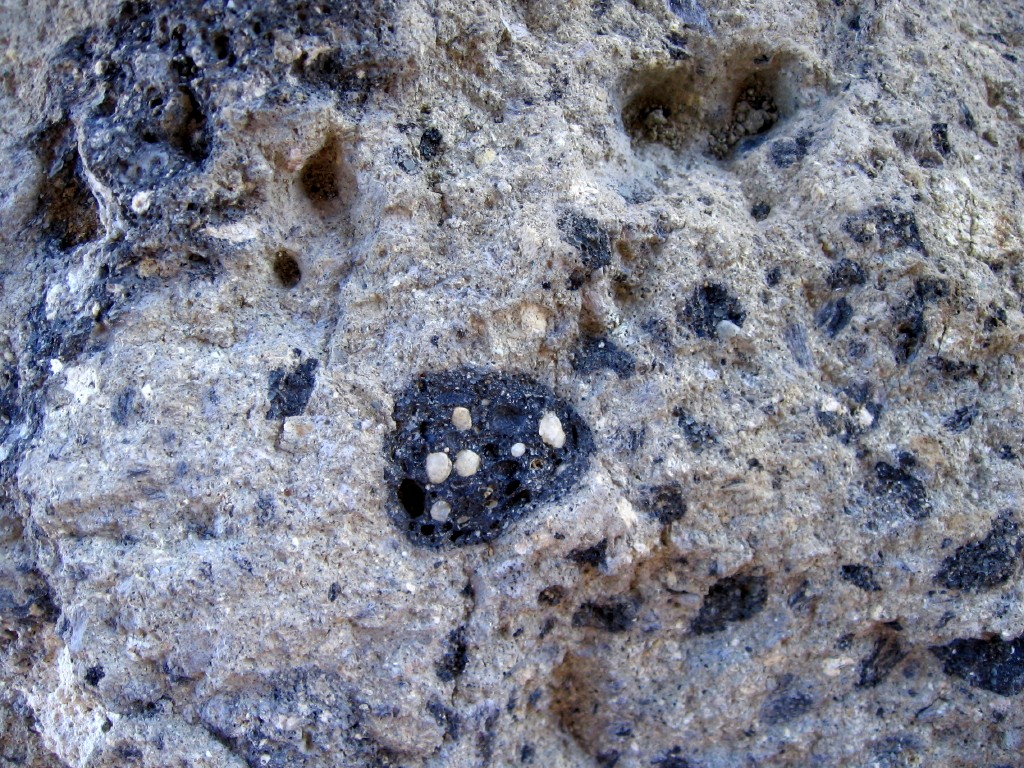
The immense pressure and heat from the impact, estimated to have exceeded 60 gigapascals, transformed the local graphite-bearing gneiss rock. This process created a unique type of impact breccia called suevite, a rock composed of angular fragments of glass, crystal, and minerals. Within this suevite are millions of microscopic diamonds, each less than 0.2 millimeters across. The total amount of these micro-diamonds within the crater is estimated to be 72,000 tons.
A town built from stardust
When the first settlers established Nördlingen around 898 A.D., they were unaware of the crater's cosmic origin, believing it to be a volcanic caldera. For centuries, they quarried the abundant local suevite to construct their buildings. The St. George's Church, a Gothic structure with a 90-meter steeple, is built from this diamond-bearing stone. The town's medieval walls, which are still completely intact, were also constructed using the same material.
The true origin of the crater was not confirmed until the 1960s, when geologist Eugene Shoemaker identified it as an impact structure. The presence of minerals like coesite and stishovite, forms of quartz that only occur under the extreme pressure of an impact, provided definitive proof. The area's unique geology made it an ideal training ground for Apollo 14 and 17 astronauts, who learned to identify impact rocks before their lunar missions. Today, the European Space Agency continues to use the site for astronaut training.
💡Fun Facts
The Ries impact is believed to be the source of moldavite, a green tektite glass found up to 450 km away in the Czech Republic.
Until the 1960s, the crater was thought to be of volcanic origin.
Apollo 14 and 17 astronauts, including Alan Shepard and Eugene Cernan, trained here in 1970 to recognize lunar impact rocks.
The impact created an earthquake estimated at magnitude 8 on the Richter scale.