Far above our heads, invisible 'bubbles' and 'blobs' of plasma disrupt satellite signals and create radio blackouts.
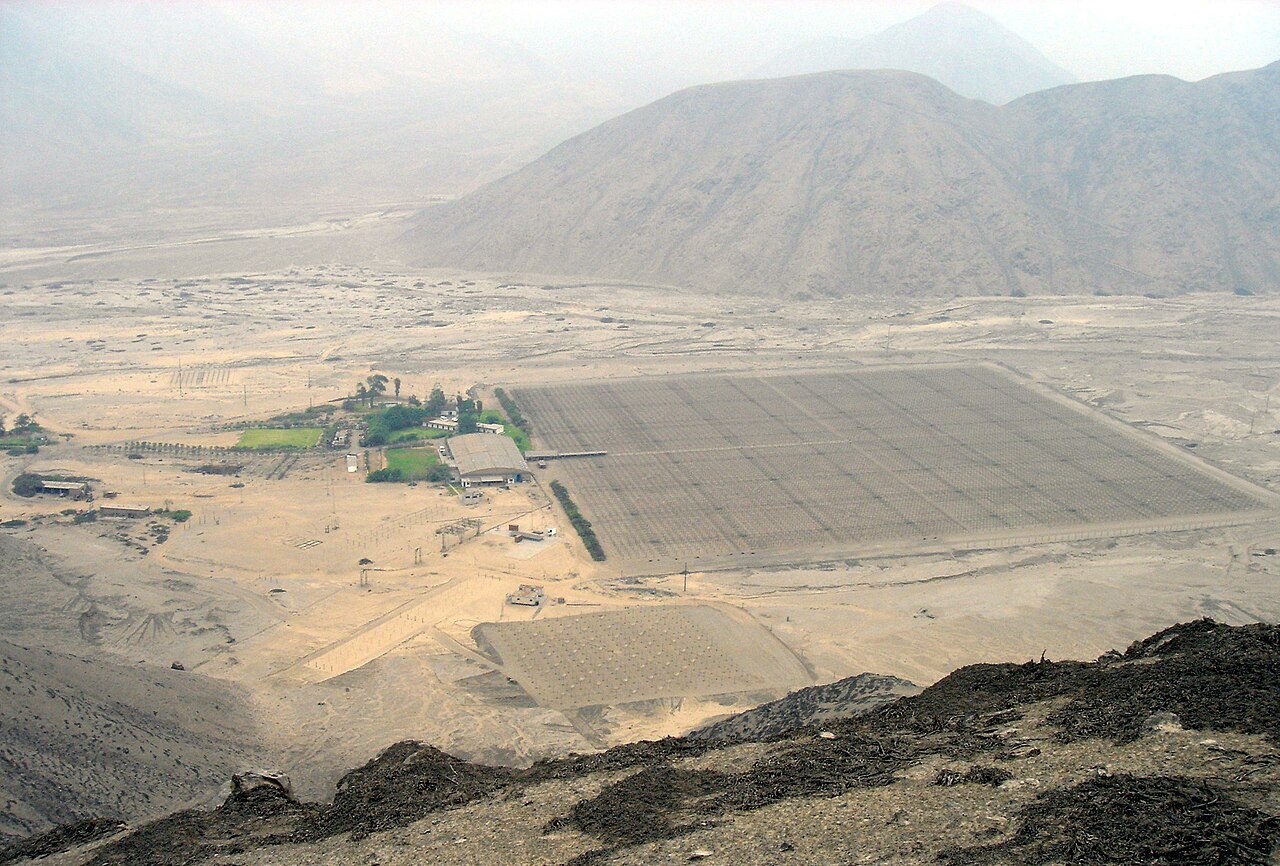
Jicamarca Radio Observatory (JRO), Public domain, via Wikimedia Commons
Riptides in the upper atmosphere
Extending from 60 to 1,000 kilometers above the Earth is the ionosphere, a vast region where solar radiation strips electrons from atoms, creating a sea of electrically charged gas called plasma. Every evening shortly after sunset, this region above the planet's magnetic equator becomes unstable. Pockets of lower-density plasma, some as wide as 100 kilometers, begin to rise through the denser plasma above them, much like bubbles in boiling water. This process is a form of the Rayleigh-Taylor instability, a fundamental fluid dynamics principle that occurs when a heavier fluid sits on top of a lighter one.
These structures are known as Equatorial Plasma Bubbles (EPBs). They are not small; a single bubble can stretch for hundreds of kilometers vertically and thousands of kilometers along the Earth's magnetic field lines. As they develop, these bubbles can drift eastward at speeds ranging from 60 to 175 meters per second. This entire process is a part of the day-night cycle in the equatorial ionosphere and is not directly tied to major space weather events like solar storms.
A laboratory in the sky
The specific coordinates point near the Jicamarca Radio Observatory, a premier scientific facility located just outside Lima. Built in the early 1960s, Jicamarca is the world's most powerful incoherent scatter radar dedicated to studying the equatorial ionosphere. Its main antenna is an enormous array of 18,432 dipole antennas covering an area of over 84,000 square meters. This powerful instrument allows scientists to probe the ionosphere, measuring electron density, temperature, and electric fields with high precision.
The location is ideal because near the magnetic equator, the radar can be pointed perpendicular to the Earth's magnetic field, a unique vantage point for observing the formation of EPBs. When radio signals from satellites, such as those from the Global Positioning System (GPS), pass through these plasma bubbles, they are scattered and distorted. This phenomenon, known as ionospheric scintillation, is similar to how Earth's lower atmosphere makes stars appear to twinkle. The effect on technology can be severe, reducing the accuracy of GPS from meters to tens of meters and sometimes causing a complete loss of signal lock. This disruption affects aviation, maritime navigation, and any technology reliant on precise satellite timing and positioning.
💡Fun Facts
The Jicamarca Radio Observatory's main radar transmits with a power of around two million watts, but the reflected signal from the ionosphere is measured in picowatts, a millionth of a millionth of a watt.
Under certain conditions, the plasma within these bubbles recombines and emits a faint light, creating streaks of "airglow" that can be observed with sensitive all-sky cameras.
The bubbles often develop complex internal structures with smaller-scale irregularities and bifurcations forming as they rise and evolve.
The process is not unique to Earth; the Rayleigh-Taylor instability that drives bubble formation is also observed in cosmic events like supernovae.