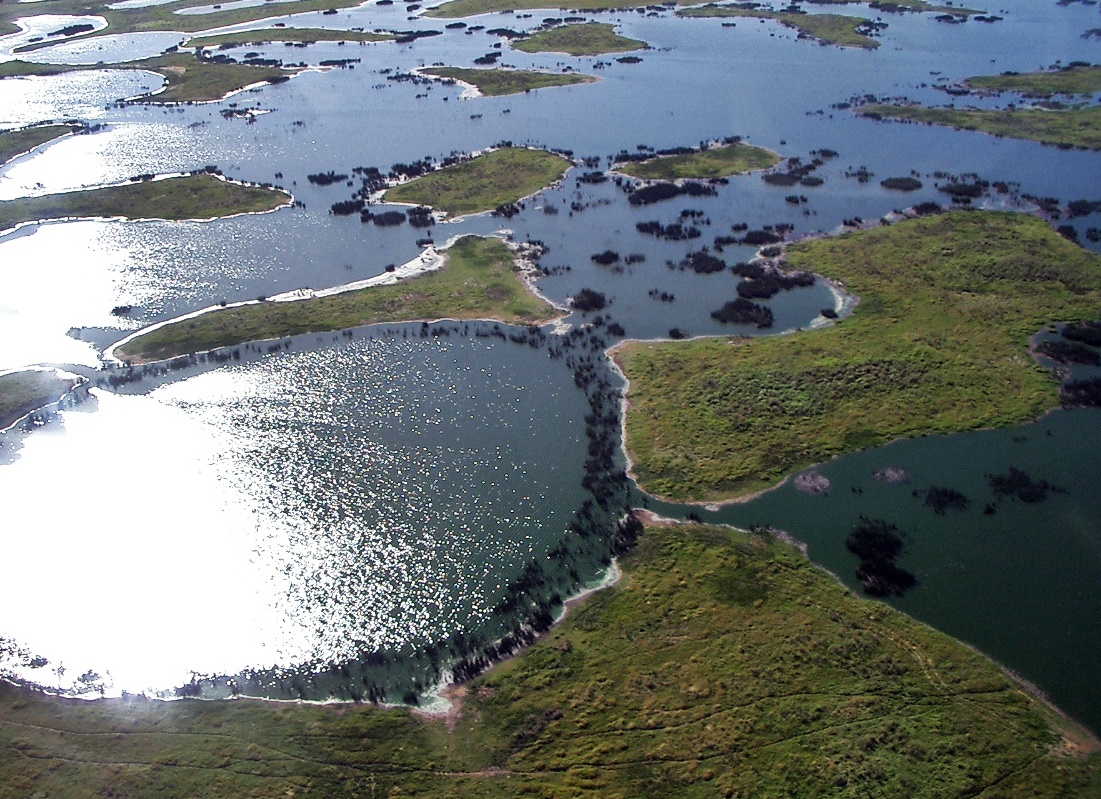
The Slow-Motion Inundation
The Pantanal's flood is not a flash event. It is a slow, predictable pulse driven by rainfall in the surrounding highlands, known as the Planalto. Rain falls heaviest between November and March, but the water moves through the vast, flat basin with extreme slowness. Due to the low gradient and dense vegetation, water flows at a speed of only 2 to 10 centimeters per second. This means the flood pulse can take several months to travel from the northern headwaters to the southern reaches of the wetland. In the north, flooding can begin almost immediately after the rains, while the southern Pantanal may not see peak water levels until July or August.
This gradual inundation submerges roughly 80% of the Pantanal's floodplain, an area that can reach up to 195,000 square kilometers. The water level of the Paraguay River, the region's main artery, can rise between two and five meters seasonally. As the rising water covers the dry soil and decaying plants from the previous season, it quickly becomes depleted of oxygen. This anoxic condition creates a challenging environment, forcing many organisms to adapt or relocate. The entire system functions as a massive sponge, slowly absorbing water during the wet season and then gradually releasing it during the dry season from April to September.
Life Governed by Water
The ecosystem's inhabitants have life cycles synchronized with the water's rhythm. As the floodplains fill, fish populations disperse from the main river channels into the newly accessible forests to feed and reproduce. Many species are detritivores, consuming fine particles from sediments and submerged plant surfaces. This annual dispersal is a period of abundance. Aquatic plants, such as the water hyacinth (Eichhornia crassipes), flourish, sometimes forming huge floating mats that can become islands for insects, reptiles, and even small mammals.
The flood dictates the hunting strategies of the Pantanal's apex predator, the jaguar (Panthera onca). While jaguars prey on many animals, the high concentration of yacare caiman (Caiman yacare) makes them a frequent target. With a powerful bite adapted to pierce skulls, jaguars are one of the few predators capable of hunting these armored reptiles. They often ambush caiman sunning on riverbanks, using their strength to drag the large reptiles away from the water. As the waters recede in the dry season (April to October), wildlife becomes highly concentrated around the remaining pools and riverbanks, making this the prime time for viewing capybaras, giant otters, and marsh deer.