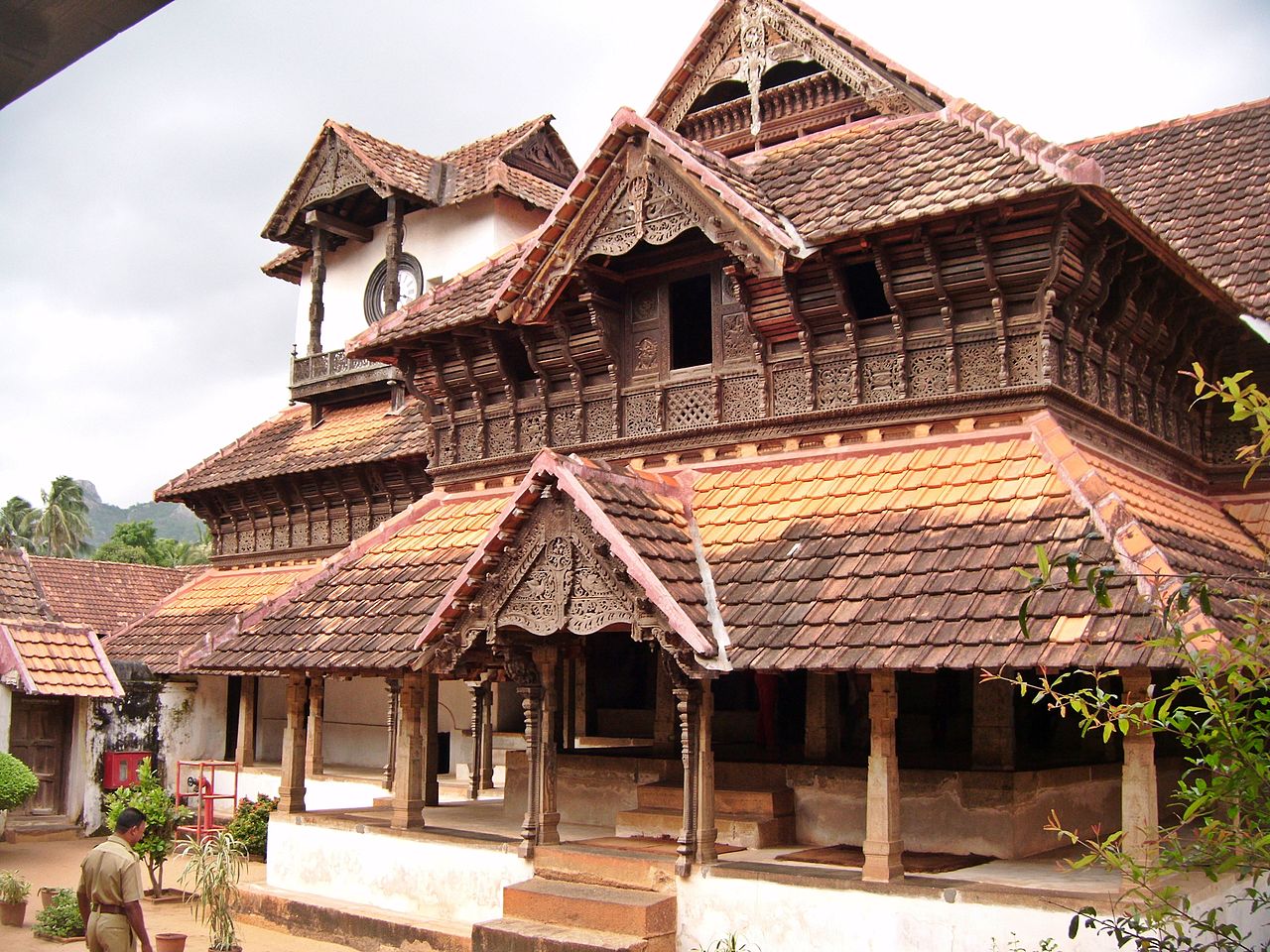
This 16th-century wooden palace stays 10°C cooler than outside through passive ventilation. Air channels, reflecting pools, and thick walls create thermal comfort without electricity. Engineering comfort through geometry.
Kumbalam, CC BY-SA 3.0, via Wikimedia Commons
Engineering thermal comfort
In the warm, humid climate of India's southern tip, the Padmanabhapuram Palace complex maintains a cool interior without any mechanical assistance. The entire 6.5-acre complex is a carefully engineered system of passive cooling, showing a sophisticated understanding of thermodynamics and airflow. The design uses principles of Kerala's traditional climate-responsive architecture to create a comfortable microclimate.
The palace's primary defense against heat is its material composition. Thick walls, some up to 1.5 meters, are built from laterite stone, a porous local rock with high thermal mass. These walls absorb heat during the day and slowly release it at night, regulating the internal temperature. The extensive use of wood, particularly teak and rosewood, also helps with cooling. Wood has low thermal conductivity, preventing heat from transferring indoors. Floors are coated in a unique, dark, gleaming plaster made from a mixture of egg whites, jaggery, lime, and burnt coconut shells, which remains cool to the touch.
A design that breathes
The palace's layout is important for its ventilation. The complex is a series of structures connected by corridors and built around multiple open-to-the-sky courtyards called nalukettus. These courtyards are the engines of the ventilation system. They create a phenomenon called the stack effect. As the sun heats the air in the courtyards, it rises and escapes, drawing cooler, denser air from the shaded verandas and rooms into the center of the structure. This process establishes a constant, gentle flow of air throughout the palace.
This natural airflow is guided and improved by specific architectural features. Steeply pitched, double-layered roofs with clay tiles deflect direct sunlight and allow hot air to escape through the gables. Carved wooden screens, or jaalis, cover windows and openings. These screens permit air to pass through freely while diffusing harsh sunlight and reducing glare, keeping the interiors both ventilated and shaded. The strategic orientation of the entire complex maximizes its exposure to prevailing breezes, ensuring effective cross-ventilation. Small ponds within the palace grounds further help with cooling the surrounding air through evaporation.
💡Fun Facts
The palace is considered the largest wooden palace complex in Asia.
Though located in the state of Tamil Nadu, the palace is administered and maintained by the government of the neighboring state of Kerala.
A four-story building in the center of the complex, the Uppirikka Malika, has walls covered in 18th-century murals made with natural pigments.
The king's bedroom contains a cot made from a mosaic of 64 different types of medicinal wood, a gift from Dutch traders.