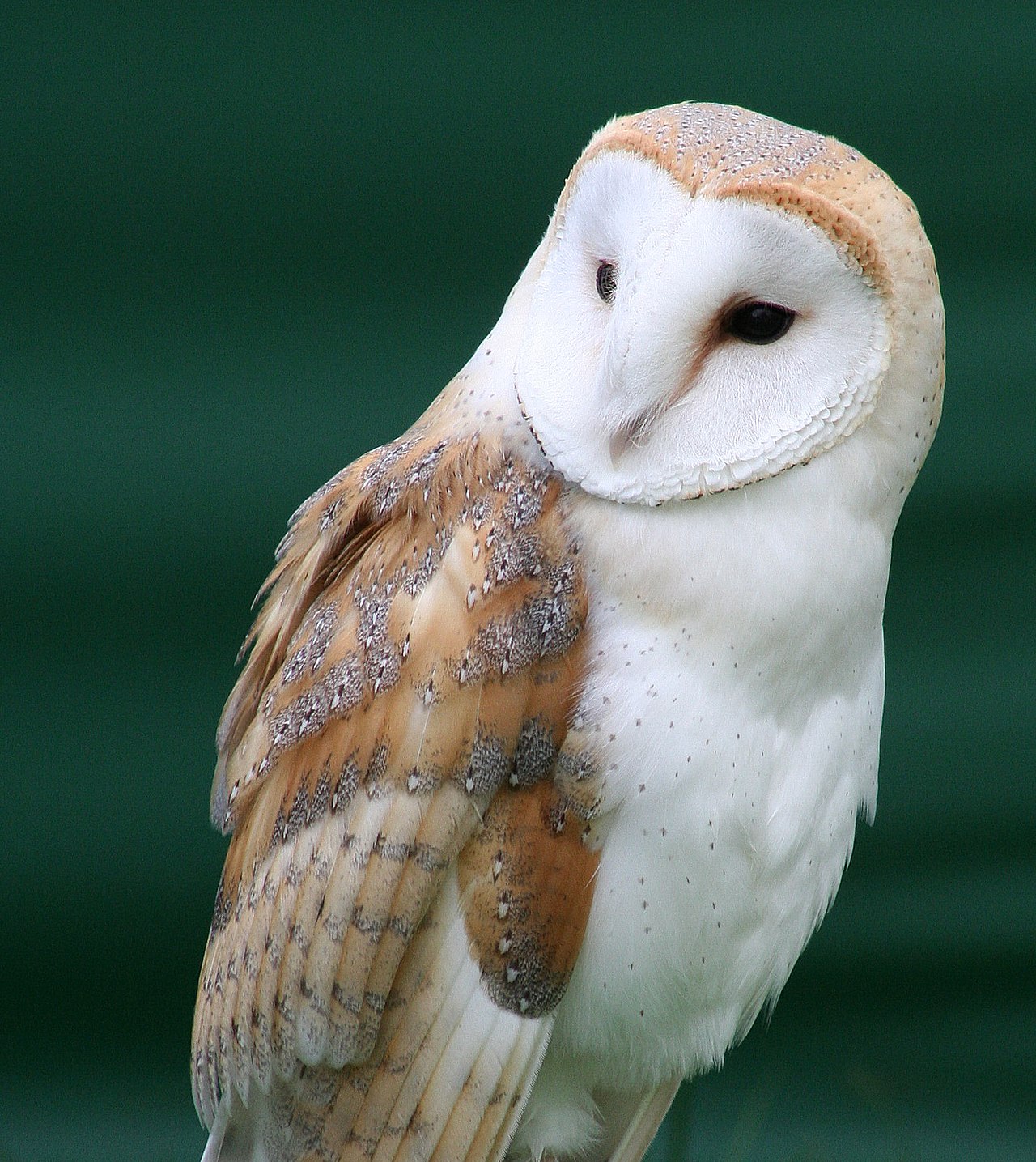
A face built for sound
An owl's face is a specialized piece of acoustic equipment. The defining feature, the facial disc, is a concave collection of feathers that functions as a sound collector, much like a parabolic dish. This disc is bordered by a facial ruff, a rim of stiff feathers that reflect sound, channeling it toward the ear openings. The feathers within the disc itself are acoustically transparent, allowing sound to pass through to the ears. By using special facial muscles, an owl can adjust the shape of the disc, effectively changing the focal length to better pinpoint sounds from different distances.
This structure is most prominent in nocturnal species that rely heavily on hearing to hunt. The Great Grey Owl (Strix nebulosa) has the largest facial disc of any bird, which allows it to hear the faint scratching of rodents moving more than a foot beneath the snow. The Barn Owl (Tyto alba) has a distinct, heart-shaped disc that provides exceptional hearing acuity. At certain frequencies, a barn owl's hearing can be ten times more sensitive than a human's. The owl's beak even contributes to the system; it points downward to minimize sound reflection away from the face, maximizing the surface area for sound collection.
Asymmetry is accuracy
Concealed by the facial disc feathers are the owl's ear openings, which are a natural engineering. In many nocturnal owl species, including the Barn Owl and Boreal Owl, the ear openings are asymmetrical. This asymmetry is not in the external feather tufts, which are for display, but in the actual skull structure, which places the ear openings at different vertical positions. In the barn owl, the left ear opening is higher than the right.
This vertical separation allows the owl to determine the elevation of a sound source. A sound coming from below will be slightly louder in the right ear, while a sound from above will register more loudly in the left. The horizontal position of a sound is determined by the brain calculating the minuscule time difference between when a sound wave arrives at each ear. An owl can detect an interaural time difference as small as 30 millionths of a second (0.00003 seconds). By processing these differences in time and volume, the owl's brain constructs a precise, three-dimensional mental map of its auditory environment, allowing it to strike prey in complete darkness with incredible accuracy. Removing the facial ruff feathers severely impairs an owl's ability to localize sound in elevation, though its horizontal accuracy remains intact.