An Unmarked Cemetery
In 1961, an archaeological team led by Ezzatollah Negahban investigated a natural, rocky mound called Cherāgh-Ali Teppa near the Gohar Rud river. For 14 months, they excavated the hill, which local accounts suggested was full of snakes—giving it the name Marlik. The team uncovered 53 tombs, showing a royal necropolis of a previously unknown culture that flourished between the late 2nd and early 1st millennium BCE. This corresponds to the late Bronze Age and early Iron Age.
The tombs themselves are scientifically informative. Their construction varies from simple pits to more complex structures with walls made of stone slabs joined by mud mortar. Tombs range in size from small, 1.5-by-1-meter pits to large chambers measuring 7 by 4.5 meters. Some of the most elaborate tombs are built entirely from a yellowish stone imported from about 15 kilometers away, indicating the high status of the individuals buried within. Due to soil conditions, very few skeletal remains survived, but where they did, bodies were laid on their sides on a stone slab, surrounded by grave goods.
A Voiceless Culture's Material Record
The Marlik necropolis yielded over 25,000 individual artifacts, providing the only data on this forgotten kingdom. The collection includes a vast arsenal of bronze weaponry: swords, daggers, over 1,000 arrowheads, and maces. One tomb alone, considered a "warrior-king" burial, contained 180 artifacts, including weapons and dozens of gold buttons.
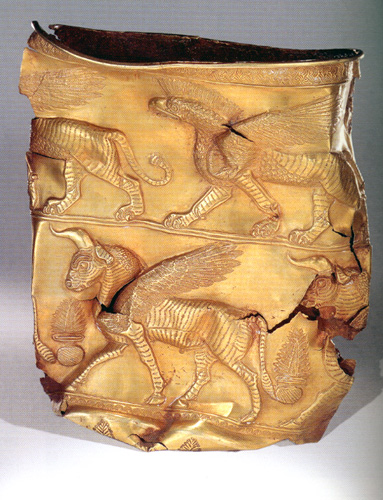
The gold and silver vessels are the most celebrated finds. One 18-centimeter-tall gold beaker, worked in repoussé, shows two winged bulls flanking a tree. These objects, along with bronze and terracotta figurines of humped bulls, stags, and humans, give a detailed record of the culture's fauna, mythology, and exceptional metalworking technology. Scientific analysis of the metal objects shows they are primarily tin-bronze alloys, showing a sophisticated command of metallurgy. The absence of any written language means these artifacts are the only voice the Marlik people have.
Scientific Clues to a Lost People
The burials at Marlik offer direct physical evidence of the culture's belief systems and social structure. Several tombs contain complete horse skeletons, buried with their owners along with bronze trappings. This practice, along with specific types of spouted vessels, indicates a possible connection to the horse-centric cultures of Central Asia.
The wealth and type of grave goods vary dramatically between tombs, showing a clear social hierarchy. Some tombs contain over two hundred items, while others have only a single pot. Analysis of cylinder seals found at the site indicates cultural and trade connections with distant regions like Assyria and Elam. A single radiocarbon test performed on organic material from one tomb yielded a date of 1457 BCE, plus or minus 55 years, helping to anchor the necropolis in time. Without historical texts, every scientific analysis from metallurgy to zooarchaeology is an important tool for reconstructing the world of this lost kingdom.