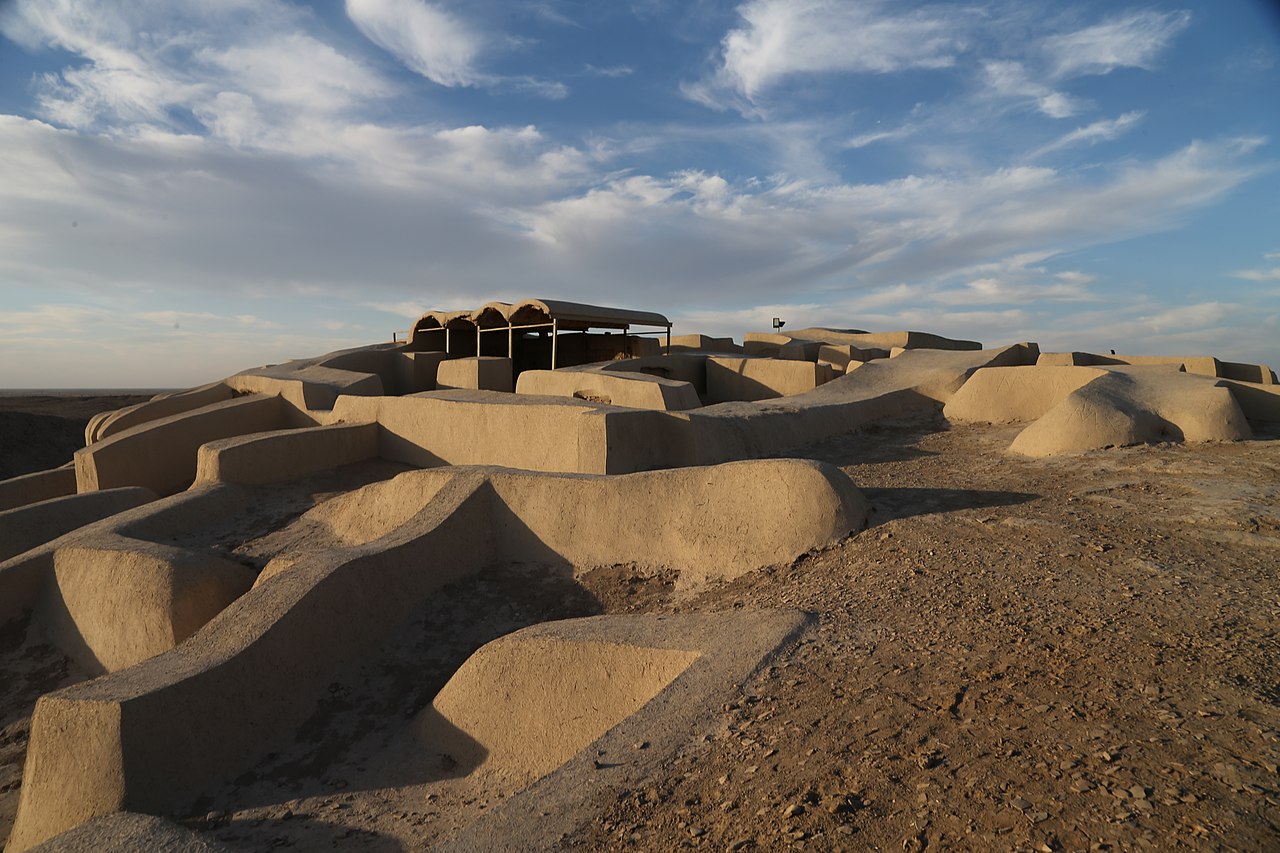
A Bronze Age metropolis of firsts
Shahr-e Sukhteh, or "The Burnt City," is a Bronze Age archaeological site that is a large urban settlement from the 3rd millennium BC. The city was established around 3200 BC and remained inhabited for over a millennium, with four distinct periods of civilization before its final abandonment around 1800 BC. Covering an area of 151 hectares, it was one of the largest cities of its time. Located at the junction of trade routes crossing the Iranian Plateau, it maintained cultural and commercial links with civilizations in the Indus Valley, the Persian Gulf, and Central Asia. The dry desert climate has led to the exceptional preservation of artifacts and organic materials.
Excavations have revealed a well-planned city with distinct zones for monumental structures, residential quarters, manufacturing, and a vast cemetery containing an estimated 25,000 to 40,000 graves. The city's inhabitants were skilled farmers and craftspeople, and finds of metals, stone vessels, and gems indicate it was a major center for producing these goods. One notable aspect of Shahr-e Sukhteh is the absence of weapons, suggesting a peaceful society. The reasons for the city's rise and eventual abandonment remain a subject of study, with theories pointing to shifts in water courses and climate change.
Pioneering discoveries
In December 2006, archaeologists at Shahr-e Sukhteh found: the world's earliest known artificial eyeball. Found in the grave of a woman dated to between 2900 and 2800 BC, the prosthetic has a hemispherical shape with a diameter just over 2.5 centimeters. It is made of a very light material, likely a bitumen paste, and its surface is coated in a thin layer of gold. Engraved on the surface is a central circle for the iris, with fine gold wires, resembling sun rays, that would have simulated capillaries. Two tiny holes were drilled on the sides, allowing a golden thread to hold the prosthesis in place. Microscopic analysis of the woman's eye socket revealed imprints from the thread, confirming she wore the eye during her lifetime. The woman herself was unusually tall for her era, standing 1.82 meters (6 feet).
The site has produced other important objects. A goblet, dated to circa 3178 BC, features five sequential images of a Persian Desert Ibex leaping to eat leaves from a tree, which archaeologists consider to be the earliest known example of animation. Another find is one of the oldest known backgammon sets, complete with dice and 60 game pieces made from turquoise and agate. The rectangular board, crafted from ebony imported from India, has an engraved serpent coiling to form twenty playing slots. Evidence of early medical practices includes a skull of a young girl showing traces of brain surgery.