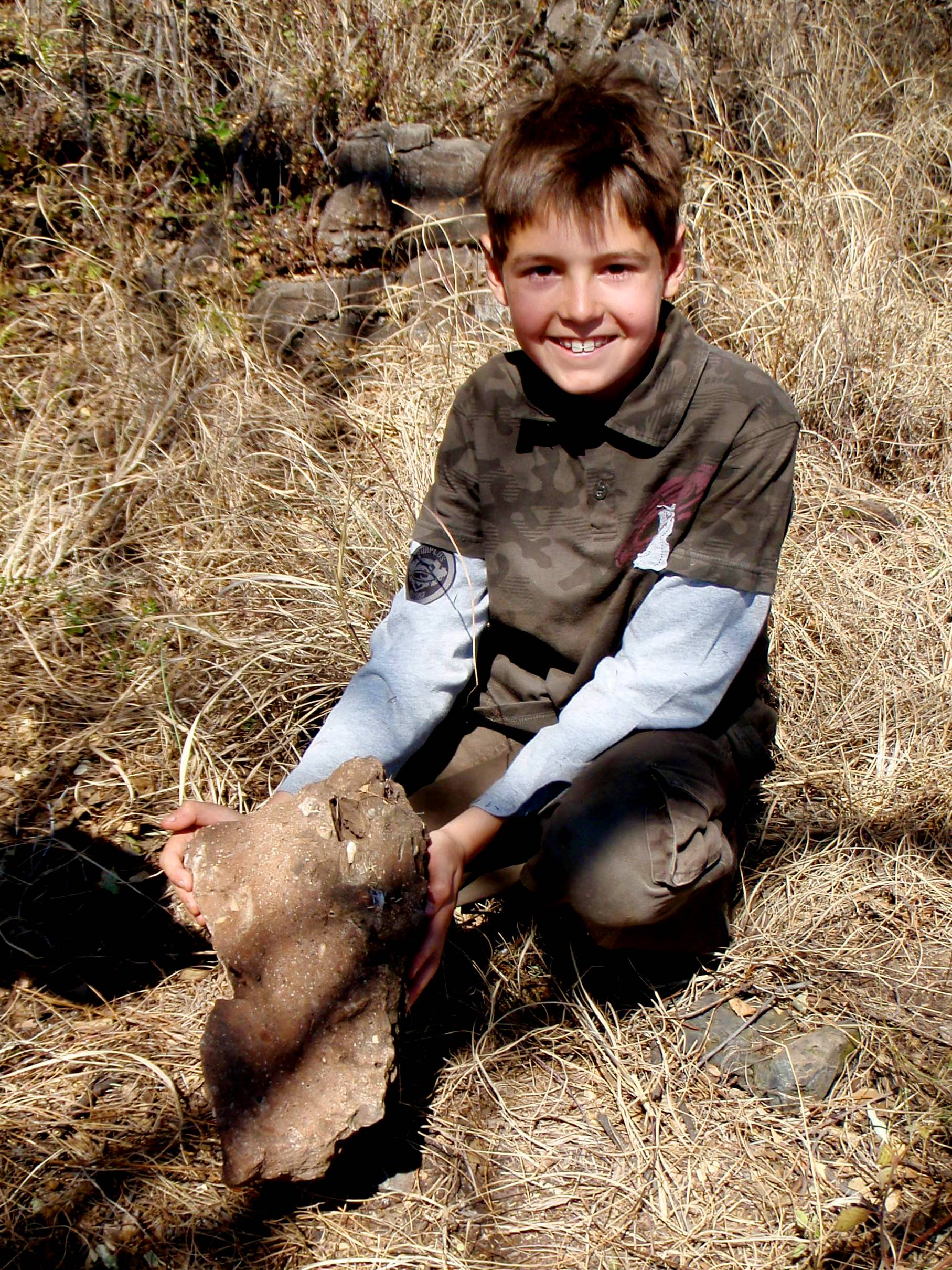
Australopithecus sediba skeletons discovered by a 9-year-old boy in 2008. They show a mix of primitive and human-like features that is hard to classify.
Profberger, CC BY-SA 3.0
A Serendipitous Stumble
On August 15, 2008, nine-year-old Matthew Berger was chasing his dog near an excavation site run by his paleoanthropologist father, Lee Berger. He tripped and stumbled upon a fossilized bone protruding from a rock. This accidental find was the clavicle of a juvenile male hominin, the first specimen of a new species. The site was Malapa Nature Reserve, part of the Cradle of Humankind, a UNESCO World Heritage site about 50 kilometers northwest of Johannesburg.
The area's geology, characterized by a complex system of limestone caves, created natural death traps. Over millennia, animals would fall into deep, hidden shafts, and their skeletons were preserved in the sediment that washed in after them. The initial discovery led to the excavation of two remarkably complete partial skeletons: MH1, the juvenile male Matthew found, and MH2, an adult female. Dating methods, including uranium-lead and paleomagnetism, established their age with high precision at approximately 1.98 million years old. These skeletons represent some of the most complete remains of any early human ancestor ever found.
A Mosaic of Features
The new species was named Australopithecus sediba, with "sediba" meaning "fountain" or "wellspring" in the local Sesotho language. The fossils show a confusing mix of traits from both the older, more ape-like Australopithecus and the more modern genus Homo. This anatomical mix makes classification difficult and shows evolution in progress.
Primitive, australopith-like features include long arms and a powerful upper chest adapted for climbing, along with a small braincase of about 420 cubic centimeters. Yet, A. sediba also has surprisingly human-like characteristics. The teeth are small, the face juts out less than its predecessors, and the pelvis is shaped for efficient, upright walking. The hand is unique; while it has curved fingers suited for climbing, it also has a long thumb and short fingers, suggesting a precision grip capable of making and using tools.
The foot and ankle are equally unusual, combining a human-like arch and Achilles tendon attachment with a primitive, ape-like heel. This suggests A. sediba walked bipedally, but with a unique gait involving significant inward rotation of the foot with each step. This combination of traits has led to debate among scientists about whether A. sediba is a late-surviving australopithecine or a direct ancestor of the genus Homo.
💡Fun Facts
The name of the boy who found the first fossil is Matthew Berger, and he was chasing his dog, Tau, when he made the discovery.
Analysis of microscopic plant particles (phytoliths) from plaque on the fossils' teeth revealed that *A. sediba* ate forest foods, including fruit, leaves, and, surprisingly, wood and bark.
The name "sediba" was chosen to reflect the species' potential importance as a source in the stream of human evolution.
Besides the hominins, fossils of saber-toothed cats, mongooses, antelopes, and the earliest known baboon have also been found at the Malapa site.
The Malapa dig site itself is an active research area not generally open to the public. However, exclusive guided tours of Malapa and the nearby Gladysvale site can be booked through the Greater Cradle Nature Reserve. These tours run Monday to Sunday, with morning tours typically starting at 08:45. The main visitor center for the Cradle of Humankind, Maropeng, is open daily from 09:00 to 17:00.
Admission
Access to the Malapa site is via specialized tours with their own pricing. A combination ticket for the Maropeng Visitor Centre and the nearby Sterkfontein Caves is available for adults and children.
Accessibility
The terrain at the Malapa site is natural and uneven. The Maropeng Visitor Centre is wheelchair accessible, but the Sterkfontein Caves tour involves numerous stairs and narrow passages and is not accessible for visitors with mobility impairments.