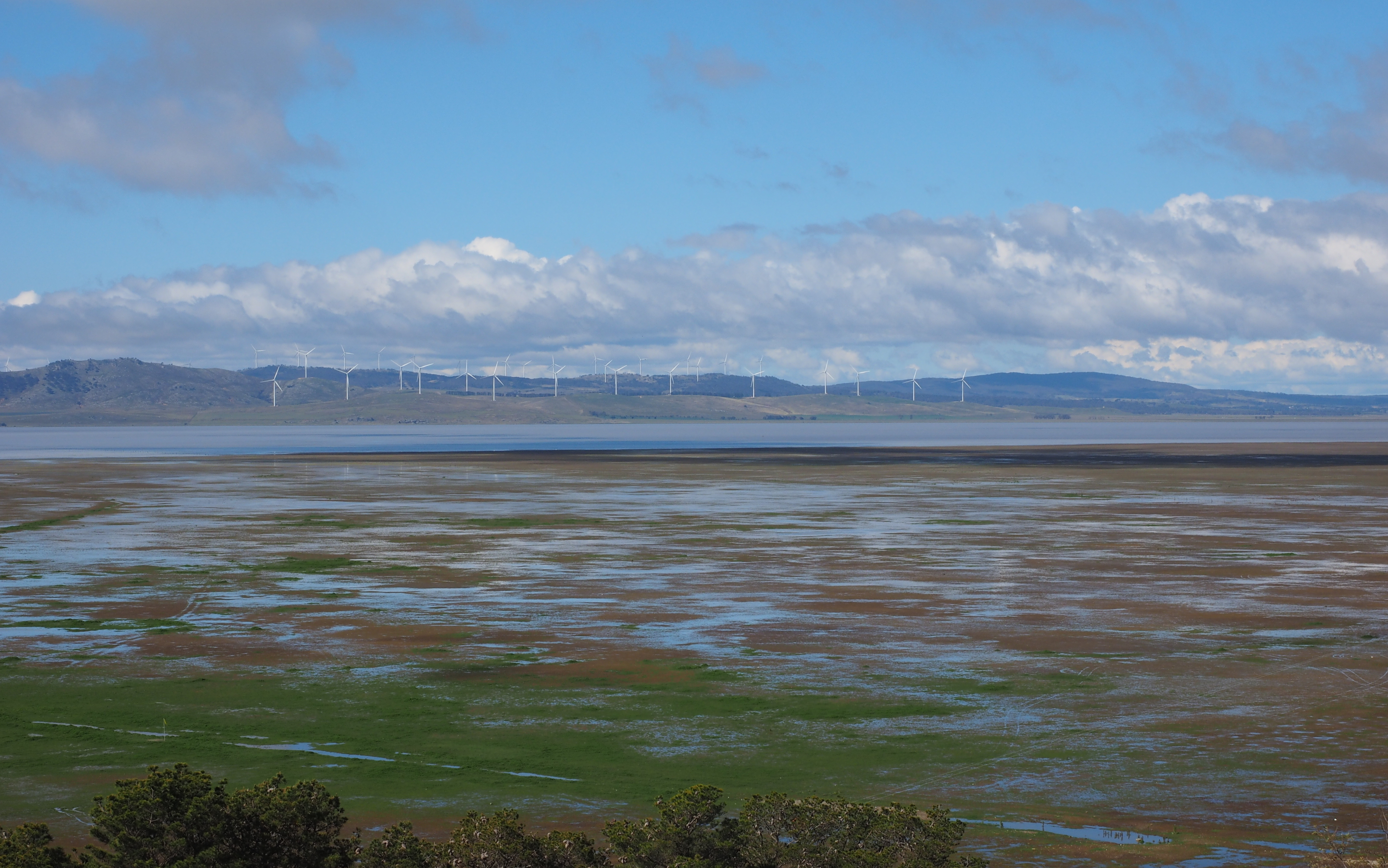
Sediments recording 4 million years of Earth's magnetic field flipping. The polarity reversals correlate with extinction pulses, hinting that magnetic shields affect evolution.
Nick-D, CC BY-SA 4.0
A Tectonic Tape Recorder
Lake George, or Weereewaa, is not a typical lake. It occupies a tectonic depression called a half-graben, formed by the Lake George Fault. This geological structure has made the lake a perfect sediment trap for millions of years. Unlike most lakes, it has no outlet, meaning the layers of sediment that wash into it remain undisturbed, creating one of the longest continuous climate records in any Australian lake basin. Scientists from institutions like the Australian National University have drilled sediment cores deep into the lakebed, with some reaching over 70 meters. Extrapolation of sedimentation rates suggests the oldest sediments at the base could be around 4 million years old. This layered archive of mud and clay is a high-resolution record of Australia's past climate and environment.
The lake itself is ephemeral, sometimes a vast body of water after heavy rains and at other times a grassy plain grazed by sheep. This cycle of wet and dry periods, corresponding to glacial and interglacial periods, is also recorded in the sediment layers.
Reading the Magnetic Signal
The sediments of Lake George contain a record. As tiny magnetic minerals, like magnetite, washed into the lake over millennia, they aligned themselves with Earth's magnetic field before settling on the bottom. This orientation becomes locked in as the sediment compacts, recording the planet's magnetic polarity at that moment in time. By analyzing the magnetic orientation of particles at different depths in the sediment cores, scientists can reconstruct the history of the Earth's geomagnetic field.
This paleomagnetic data from Lake George shows a detailed timeline of when the planet's north and south magnetic poles have swapped places. The most recent major switch, the Brunhes-Matuyama reversal, occurred around 781,000 years ago. The record within Lake George captures this and other, more temporary, "excursions" of the magnetic poles. One such event, the Laschamps Excursion, happened around 41,000 years ago, when the poles flipped for about 800 years before returning to their original positions. During these events, the Earth's magnetic shield weakens significantly. The Laschamps event saw the field strength drop to as low as 6% of its present-day power. This weakened shield allows more cosmic radiation to bombard the planet, which some studies have linked to major environmental changes, climate shifts, and even mass extinction events, like the disappearance of Australian megafauna around 42,000 years ago.
💡Fun Facts
Lake George is an endorheic lake, which means it has no outflowing river. Water only leaves through evaporation.
The lake's Indigenous name is Weereewaa, which is thought to mean "bad water" or refer to the fact it often dries up.
The last full, sustained reversal of Earth's magnetic poles was the Brunhes-Matuyama reversal, which happened roughly 781,000 years ago.
During magnetic reversals, the planet's protective magnetic field can weaken to a fraction of its normal strength, increasing radiation at the surface.