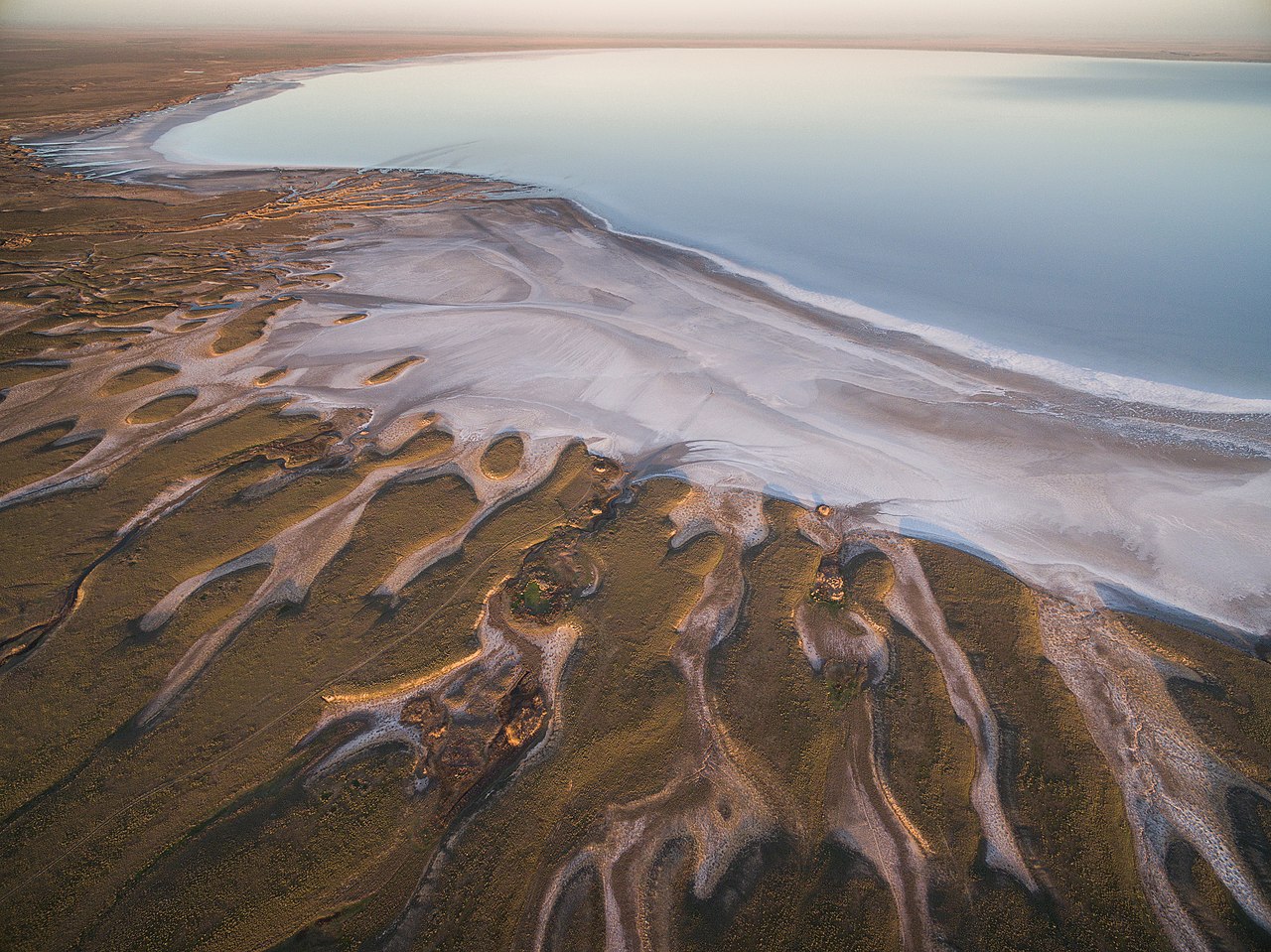
A Permian Salt Dome's Pink Bloom
Lake Elton is a vast, shallow salt lake, the largest in Europe, with a surface area of 152 square kilometers. Its surface sits about 18 meters below sea level. The lake's origin lies in a massive underground salt dome, a remnant of the Permian period when a great sea covered this region. This dome continues to push slowly upwards, feeding the lake with salt. The water's extreme salinity fluctuates between 200 and 500 grams per liter, a concentration 1.5 times higher than that of the Dead Sea.
The lake's depth is ephemeral, reaching a maximum of 1.5 meters in the spring after snowmelt and shrinking to a mere 5-7 centimeters in the heat of summer. This evaporation leaves behind the shimmering crystalline salt flats. The water itself is salty; it's a dense brine, or "rapa," rich in chlorides, sodium, and potassium. Beneath the salt deposits lies a layer of mineral-rich hydrogen sulfide mud. The lake's pink, red, and golden hues are not from the salt itself, but from life. Microscopic, salt-loving algae, specifically Dunaliella salina, thrive in the hypersaline water. To protect themselves from the intense sunlight, these organisms produce high concentrations of beta-carotene, the same pigment that colors carrots, which stains the water in shades from rose to deep red.