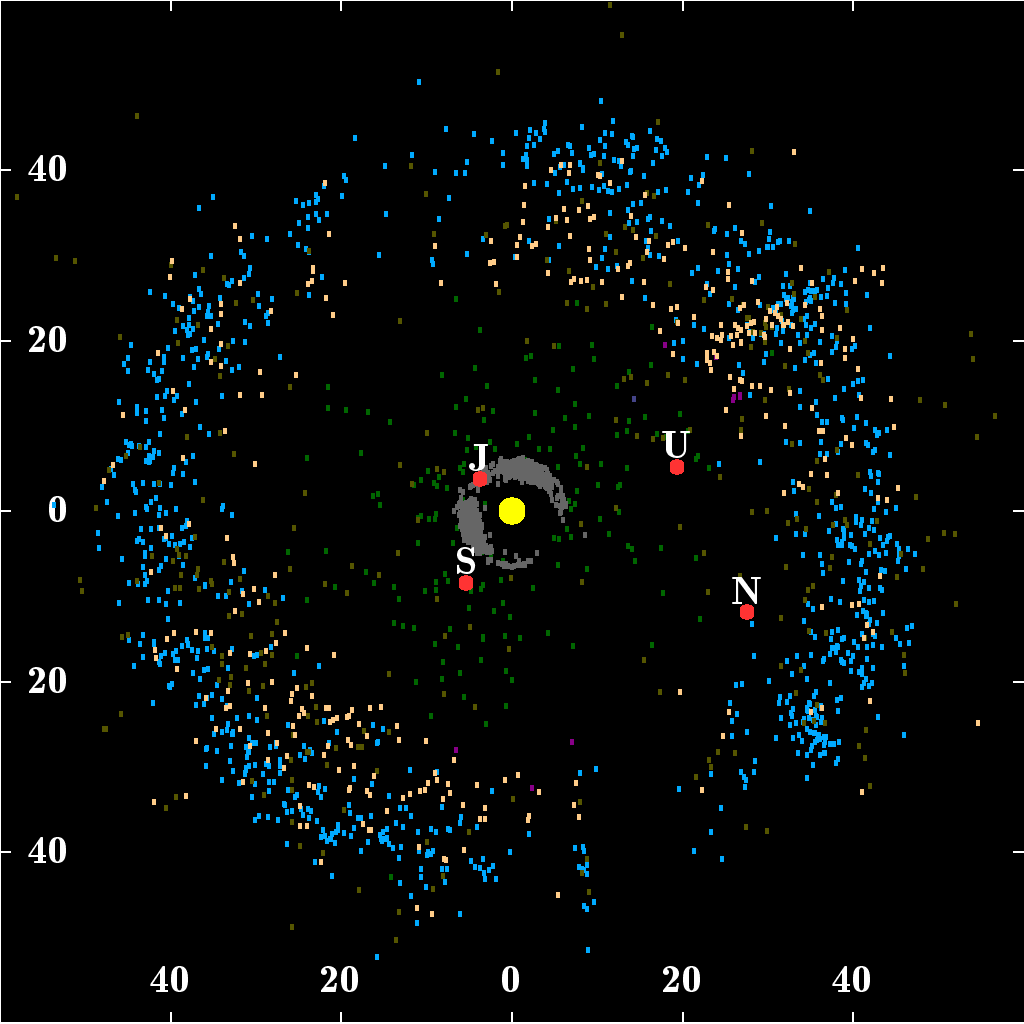
The Kuiper Belt suddenly ends at 50 AU with no clear reason. Theories include a rogue planet or original solar system conditions.
WilyD at English Wikipedia, CC BY-SA 3.0, via Wikimedia Commons
The Edge of Emptiness
Beyond the orbit of Neptune lies a vast, icy debris field known as the Kuiper Belt. This region, stretching from roughly 30 to 50 astronomical units (AU) from the Sun, hosts thousands of known icy bodies and several dwarf planets, including Pluto. An AU is the distance from the Earth to the Sun, approximately 150 million kilometers. Based on models of solar system formation, astronomers expected the number of Kuiper Belt Objects (KBOs) to continue well beyond 50 AU, perhaps even increasing.
Instead, at approximately 50 AU, the population of large KBOs plummets. This sudden, drastic falloff is known as the Kuiper Cliff. It is an unexpected boundary where the outer solar system as we know it seems to terminate. This sharp edge defies early predictions, which suggested a far more gradual tapering of objects into interstellar space. The discovery of this cliff, primarily through telescopic surveys, has presented a persistent puzzle for planetary scientists.
Explaining the Cliff
Several theories attempt to explain why the solar system has this abrupt boundary. One leading hypothesis involves a large, undiscovered planet orbiting far beyond Neptune, often called Planet Nine. Proponents of this theory, like astronomers Konstantin Batygin and Michael Brown, suggest a planet 5 to 10 times the mass of Earth could have gravitationally cleared out the region beyond 50 AU. Its immense gravity would have either ejected objects from the solar system entirely or herded them into peculiar, clustered orbits.
Another possibility is that the cliff is a fossil from the solar system's birth. Early in its history, a close pass by another star could have gravitationally sheared off the outer edges of the protoplanetary disk, truncating the material available to form KBOs. A third explanation suggests the solar system simply formed this way. The initial disk of gas and dust may not have extended much farther than 50 AU, meaning the cliff is not an edge that was carved out, but the original boundary of our solar system's building materials. Data from NASA's New Horizons spacecraft, which flew past the KBO Arrokoth, provides clues about the primordial conditions in this distant region.
💡Fun Facts
The Kuiper Belt is named for astronomer Gerard Kuiper, who hypothesized its existence in 1951.
The distance to the Kuiper Cliff is over 7.5 billion kilometers (about 4.6 billion miles).
It took NASA's New Horizons spacecraft, launched in 2006, nearly a decade to reach the Kuiper Belt.
The first KBO, other than Pluto, was not discovered until 1992.