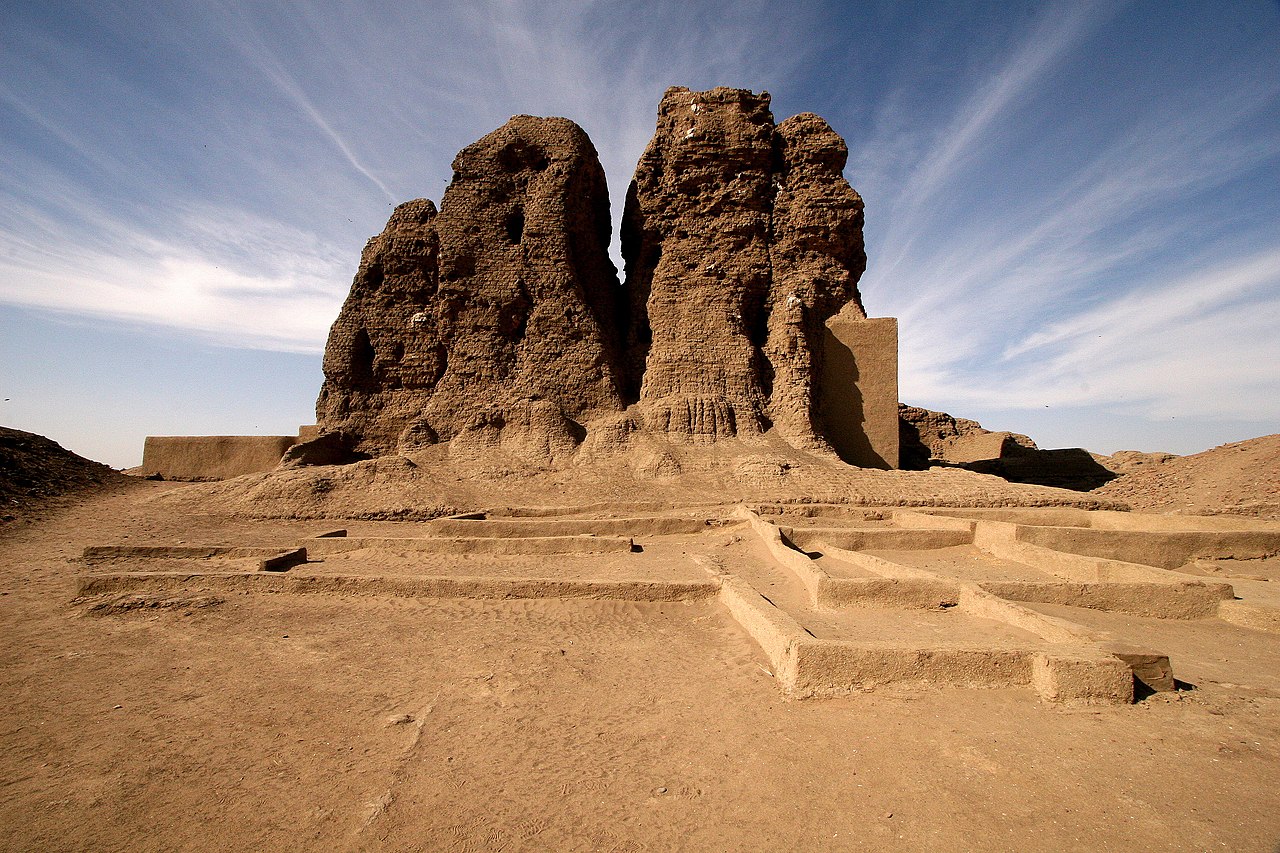
A temple of solid earth
The Western Deffufa is a massive, solid structure made almost entirely of sun-dried mud bricks. Rising approximately 18 to 19 meters from the desert floor, its base measures about 50 by 25 meters. Unlike Egyptian pyramids or ziggurats, the core of the Deffufa contains no internal chambers or tombs. Instead, a single steep staircase ascends the exterior, leading to a summit where a shrine or altar once stood. A limestone altar suggests that ceremonies, including animal sacrifices, were performed on the roof platform.
The building's name comes from a local Nubian word for a large mud-brick structure. Its construction, which began around 2500 BCE, was in the city of Kerma, the capital of the first Kingdom of Kush. The entire structure was once coated in white plaster, which would have made it a gleaming landmark against the desert terrain. Some interior walls of associated chapels were decorated with colorful paintings of animals, and some exterior portions were inlaid with stone. The temple was the religious center of a metropolis that, at its peak, may have held a population of 10,000 people.
Capital of the Kingdom of Kush
The Deffufa was the main temple in one of the earliest urban centers in sub-Saharan Africa. The Kingdom of Kerma (c. 2500–1500 BCE) was a major economic power, controlling trade routes between the African interior and Egypt. Warehouses and a palace complex discovered near the Deffufa point to royal control over the trade of gold, copper, ivory, and exotic animals. The city was protected by extensive fortifications, including walls with circular towers.
Two kilometers to the east lies a second, smaller structure known as the Eastern Deffufa. This building was a funerary chapel at the center of a vast necropolis with at least 30,000 graves. The royal tombs here are enormous circular tumuli, some reaching 90 meters in diameter. Excavations of these tombs revealed a complex and sometimes grim burial tradition. The kings of Kerma were not buried alone. One royal tomb contained the remains of more than 300 individuals, likely retainers and family members sacrificed to accompany their ruler into the afterlife. This practice of human sacrifice, along with the immense wealth of grave goods, shows the power held by the rulers of Kerma, a kingdom that for centuries rivaled its northern Egyptian neighbors.