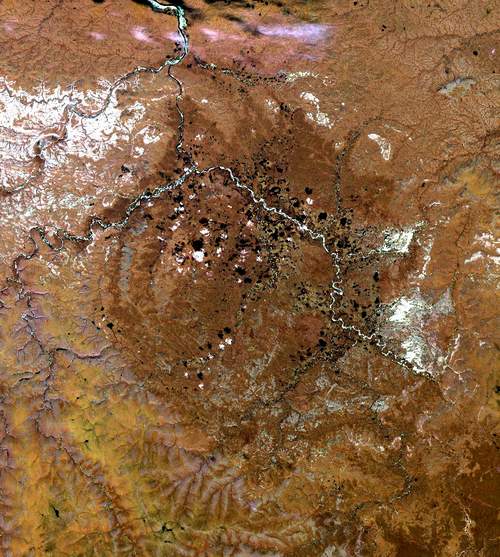
Diamonds formed in milliseconds when an asteroid struck graphite-rich rocks 35 million years ago. The Popigai crater contains trillions of carats of 'impact diamonds'. It contains more than all other deposits combined, but too small for gems.
Public domain, via Wikimedia Commons
An instant of creation
About 35.7 million years ago, during the late Eocene epoch, an asteroid between five and eight kilometers in diameter struck northern Siberia. The impactor, believed to be a chondrite asteroid, hit the Earth at a velocity of up to 20 kilometers per second. It vaporized thousands of cubic kilometers of rock and excavated a crater 100 kilometers (62 miles) wide, now known as the Popigai Crater. It is the fourth largest verified impact structure on Earth.
The asteroid struck a region of the Anabar Shield composed of ancient graphite-bearing gneiss rocks. The immense shock pressures and temperatures from the impact instantaneously transformed the graphite within the rock into diamonds. This flash formation occurred in a shell of rock located between 12 and 13.6 kilometers from the point of impact, where conditions were ideal for the diamonds to form and survive. The entire deposit, estimated to hold trillions of carats, was created in a fraction of a second.
A harder, different diamond
The gems of Popigai are known as "impact diamonds." They are not the clear, single-crystal stones found in jewelry. Instead, they are polycrystalline aggregates, typically 0.5 to 2 millimeters in diameter, that inherited the tabular shape of the graphite flakes they once were. A few exceptional specimens reach 10 millimeters in size.
Many of these diamonds contain lonsdaleite, a rare allotrope of carbon with a hexagonal crystal lattice, distinct from the cubic structure of conventional diamonds. This hexagonal structure, sometimes called "hexagonal diamond," makes the material exceptionally hard. Theoretical models and lab tests predict that lonsdaleite can be up to 58% harder than a standard diamond, making Popigai diamonds superior for industrial applications. Their abrasive strength is 1.8 to 2.4 times greater than that of synthetic diamonds. Due to their small size and cloudy appearance, their value is entirely industrial, not for jewelry.
💡Fun Facts
The diamond deposit was discovered by Soviet scientists in the 1970s but was kept secret, partly to avoid disrupting the global diamond market and because the USSR was focused on producing synthetic industrial diamonds.
The Popigai impact may be linked to the Eocene–Oligocene extinction event, a period of significant global cooling and species loss.
The crater is remarkably well-preserved due to its remote Arctic location and is designated by UNESCO as a Geopark, a site of geological heritage.
The extreme remoteness and lack of infrastructure make mining the deposit economically unfeasible, especially when compared to the low cost of manufacturing synthetic diamonds.
The crater is a remote, uninhabited wilderness area with no official hours.
Admission
Free
Accessibility
The site is extremely remote and inaccessible. There are no roads or facilities. Access is only possible via specialized expeditions, typically requiring helicopter transport from the town of Khatanga, approximately 300 kilometers away.