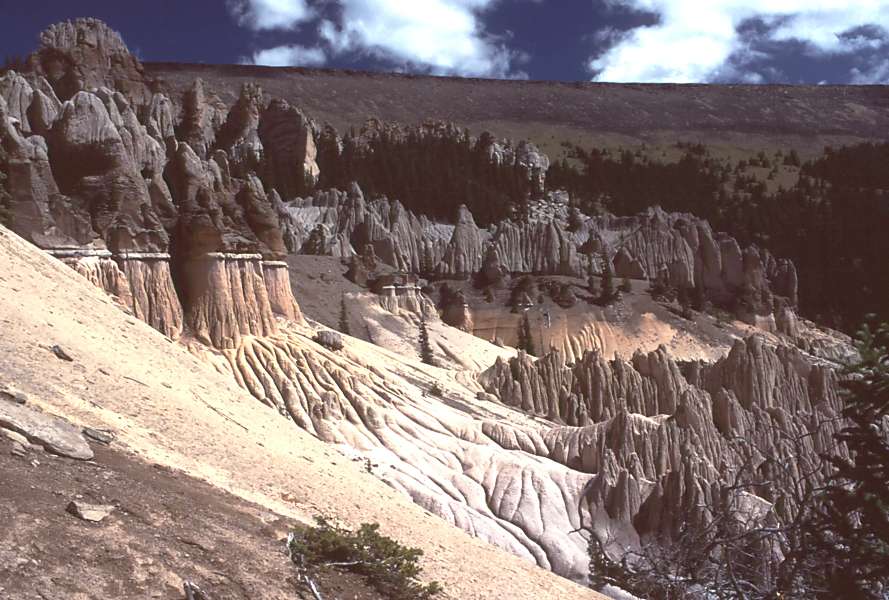
An 18-million-year-long eruption
Between 40 and 25 million years ago, a period of intense volcanic activity reshaped the western United States. This episode, the Mid-Tertiary Ignimbrite Flare-Up, was not a single event; it was a sustained series of colossal eruptions centered in three main areas: the San Juan volcanic field in Colorado, the Central Nevada field, and the Indian Peak field in Nevada and Utah. The geological trigger was the subducting Farallon Plate beneath North America. For millions of years, this plate had slid under the continent at a shallow angle, but as that process ceased, the mantle opened up, fueling widespread volcanism.
The flare-up produced enormous quantities of ignimbrite, a rock formed from the searingly hot, fast-moving clouds of ash, gas, and rock fragments known as pyroclastic flows. The total volume of erupted material included 500,000 cubic kilometers of ash flow tuff. The San Juan volcanic field, where the La Garita Caldera is located, was one of the most active zones, experiencing its peak activity between 35 and 30 million years ago. This period saw numerous volcanoes erupt and collapse, creating at least 15 distinct calderas in the region. The deposits from these eruptions are often found in thick layers, sometimes hundreds of meters deep where they were trapped by the caldera walls.