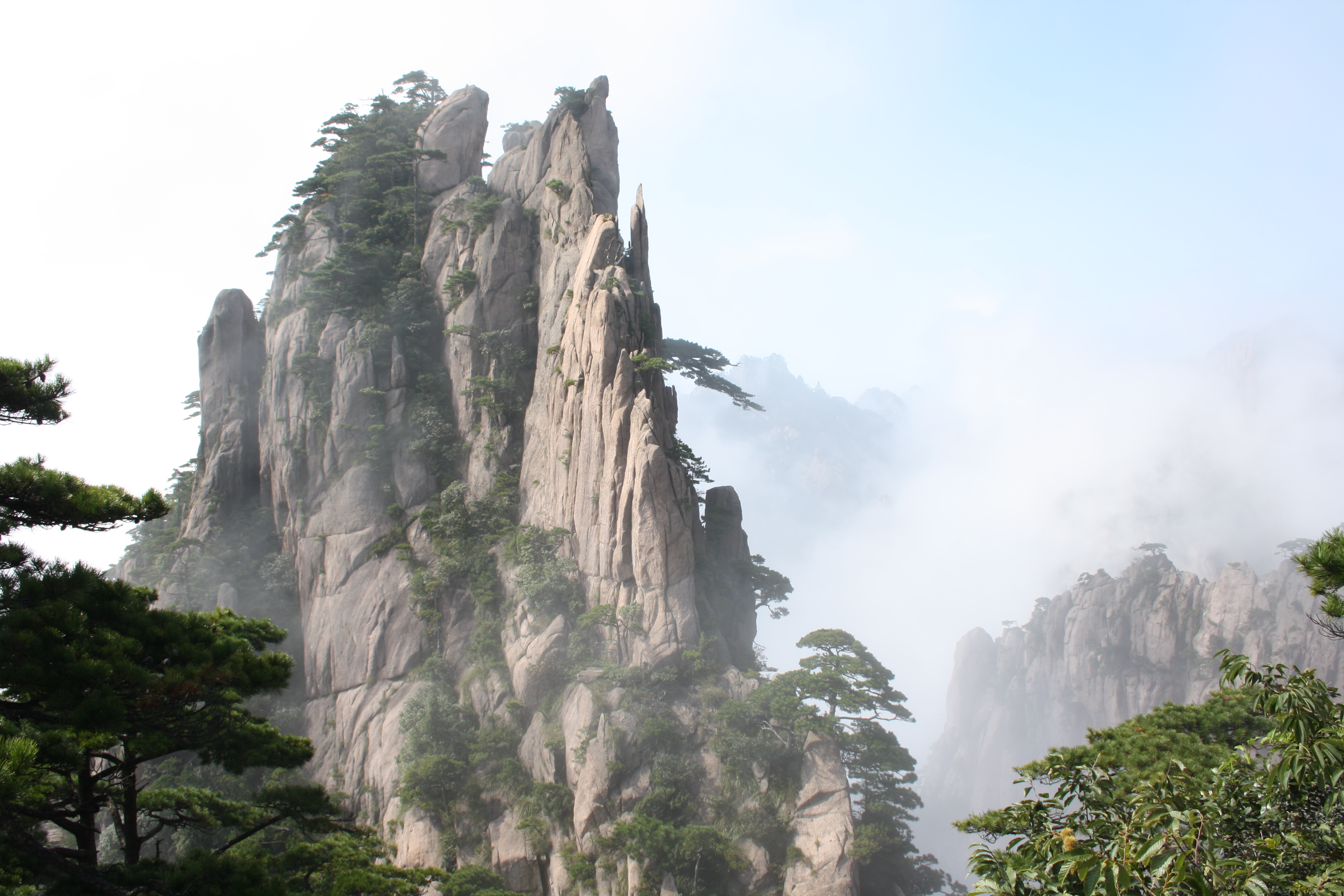
Fantastically shaped peaks form from weathering along granite joints. Cosmogenic dating shows some free-standing pillars have taken 2 million years to emerge.
Arne Hückelheim, CC BY-SA 3.0
A 140-Million-Year-Old Blueprint
The story of Huangshan's otherworldly landscape begins deep underground during the Mesozoic Era. Around 140 million years ago, a massive body of molten magma pushed its way into the Earth's crust. This magma cooled slowly, crystallizing to form the huge granitic body that is the foundation of the mountains. Specifically, geologists have used argon-argon dating to identify two major intrusions: the Taiping Granodiorite (about 137 million years old) and the Huangshan Granite (about 125 million years old).
As this granite cooled and contracted, and later as tectonic forces began to push the entire region upward around 65 million years ago, a network of cracks, or joints, formed within the rock. These joints, typically oriented in E-W, N-S, and NE-SW directions, created a grid-like pattern of weakness throughout the granite mass. This complex system of fractures defined the structure of the landscape we see today. For millions of years, this geological drama unfolded beneath a thick blanket of overlying rock, hidden from the surface.
Carving the Landscape
As uplift continued, millions of years of erosion stripped away the softer overlying rocks, finally exposing the hard granite to the elements. This is when the true sculpting began. Water, the primary agent of change, seeped into the network of joints. In winter, this water froze and expanded, a process called frost wedging, which slowly pried the joints apart. Chemical weathering also played a part, as water reacted with minerals like feldspar, turning them into weaker clay. This combination of physical and chemical attack relentlessly exploited the weaknesses defined by the joint system.
Over immense timescales, the rock along the joints weathered away much faster than the solid, unfractured blocks of granite. This process, known as differential weathering, is responsible for creating the landscape of isolated peaks, pillars, and tors. Scientists use a technique called cosmogenic nuclide dating to determine how long a rock surface has been exposed to cosmic rays. This method reveals the slow pace of erosion, showing that some of the free-standing granite pillars in Huangshan have been exposed for as long as two million years. The current dramatic landscape, with its highest peaks reaching over 1,800 meters, took its present shape around 1.75 million years ago.
💡Fun Facts
Many of the famous, gnarled Huangshan pine trees (*Pinus hwangshanensis*) are believed to be between 800 and 1,000 years old, growing directly from cracks in the granite.
The mountain has more than 60,000 stone steps, some of which are over 1,500 years old, carved by hand to make the peaks accessible.
The name Huangshan, meaning "Yellow Mountain," was given by imperial decree in 747 AD in honor of the mythical Yellow Emperor, who is said to have ascended to heaven from the peaks.
The area is often shrouded in a "Sea of Clouds" for more than 200 days a year, a phenomenon caused by the topography that traps moisture and creates a stunning visual effect.
Park hours vary by season and cable car, generally from 6:00 AM to 5:30 PM. Check the official website for current times.
Admission
Ticket prices vary by season. Expect to pay for park entry, a shuttle bus, and optional cable cars.
Accessibility
The terrain is extremely challenging, consisting mainly of steep stone stairways. Cable cars provide access to the upper scenic areas, but extensive walking and climbing are still required to reach most viewpoints.