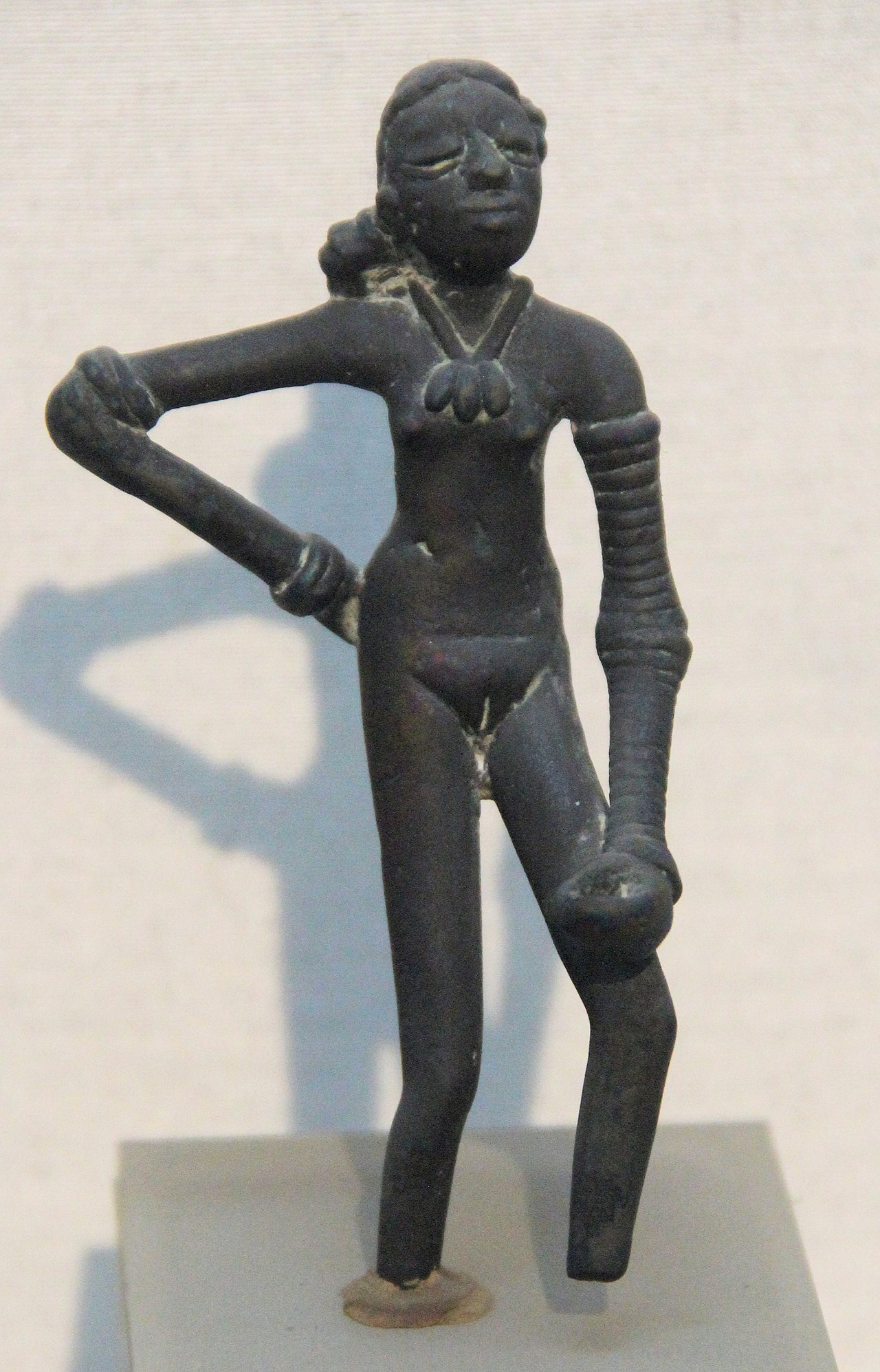
A Masterpiece in Miniature
This small bronze statuette, known as the "Dancing Girl," stands just 10.5 centimeters tall but demonstrates the metallurgical science of the Indus Valley Civilization around 2500 BCE. Discovered in 1926 by British archaeologist Ernest Mackay, the figurine depicts a slender, nude young woman. Her posture is naturalistic, with one hand on her hip and her weight shifted onto one leg in a pose art historians call contrapposto.
The figure is adorned with a simple necklace and a striking number of bangles; her left arm is almost entirely covered with about 24 bracelets, while her right arm has only four. Her long hair is styled in a bun at the nape of her neck. While this specific artifact was unearthed at Mohenjo-Daro, a major city of the civilization, its technological sophistication represents the skills found across the region, including at Harappa. Most human figurines from Indus Valley sites are terracotta, making this bronze sculpture a rare and informative example of the civilization's advanced metalworking. After its discovery, the figurine was eventually allocated to India following the partition in 1947 and is now housed in the National Museum in New Delhi.
The Science of Lost-Wax Casting
The figurine is a product of a sophisticated manufacturing process known as lost-wax casting, or cire perdue. This technique is one of the earliest methods for creating detailed metal objects and its use at this time demonstrates a deep practical knowledge of materials science. The process begins with the creation of a detailed model sculpted from wax. This wax original is then coated in layers of heat-resistant clay, forming a mold.
Once the clay mold hardens, it is heated. This step melts the wax, which drains out through small channels, leaving a hollow, negative impression of the original sculpture inside the clay shell. Molten bronze—a copper-tin alloy requiring carefully controlled high temperatures—is then poured into the cavity. After the metal cools and solidifies, the clay mold is broken away to reveal the finished bronze casting. Each mold can be used only once, making every object created with this method unique. The existence of the "Dancing Girl" confirms that Indus artisans had mastered this complex, multi-stage process over 4,500 years ago, placing them among the world's earliest and most skilled metallurgists.