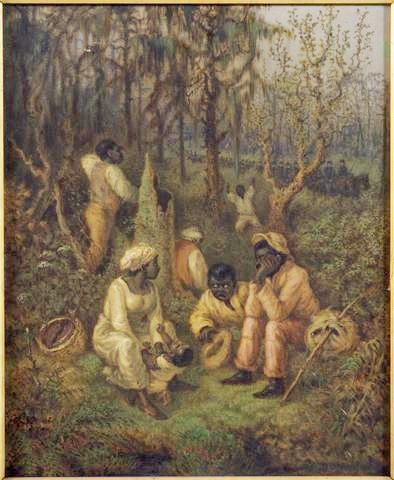
A landscape of refuge
The Great Dismal Swamp is a vast forested wetland, today covering nearly 113,000 acres across southeastern Virginia and northeastern North Carolina. It is a remnant of a system that once may have exceeded one million acres. In its center lies the 3,100-acre Lake Drummond, one of only two natural freshwater lakes in Virginia. The swamp's geology is defined by deep organic peat soils, which create highly acidic water that limits bacterial decay. This environment, inhospitable to many, became a sanctuary.
From the 17th century through the American Civil War, thousands of people escaping enslavement, known as maroons, established communities deep within the swamp. They settled on "mesic islands," patches of ground slightly higher and drier than the surrounding bog. The dense vegetation, venomous snakes, bears, and disorienting terrain that deterred outsiders provided a natural defense for these residents. The maroon communities consisted of those who had escaped slavery but also their descendants, some of whom lived their entire lives in the swamp. They were joined by Native Americans displaced by colonists, as well as free Africans and outcast Europeans.
Archaeology of resistance
Until recently, the story of the Great Dismal Swamp maroons was known primarily through historical documents and oral traditions. Since 2002, archaeological investigations led by scholars like Dan Sayers of American University have provided physical evidence of these hidden settlements. Excavations on the swamp's islands have uncovered the faint outlines of cabins and thousands of artifacts that show the residents' lives.
Finds include bits of clay pipes, nails, and gunflints, suggesting a well-established community with means of defense. Archaeologists have also found stone tools that were originally crafted by Native Americans and later found and repurposed by the maroon inhabitants. The acidic peat soil that makes excavation difficult also helps preserve organic materials, though it has likely disintegrated any human remains. These artifacts show how the maroons built a self-sufficient society. They hunted, foraged for edible plants, and possibly cultivated small gardens. They also engaged in a hidden economy, trading with enslaved laborers who were forced to work on the swamp's periphery cutting timber or digging canals.