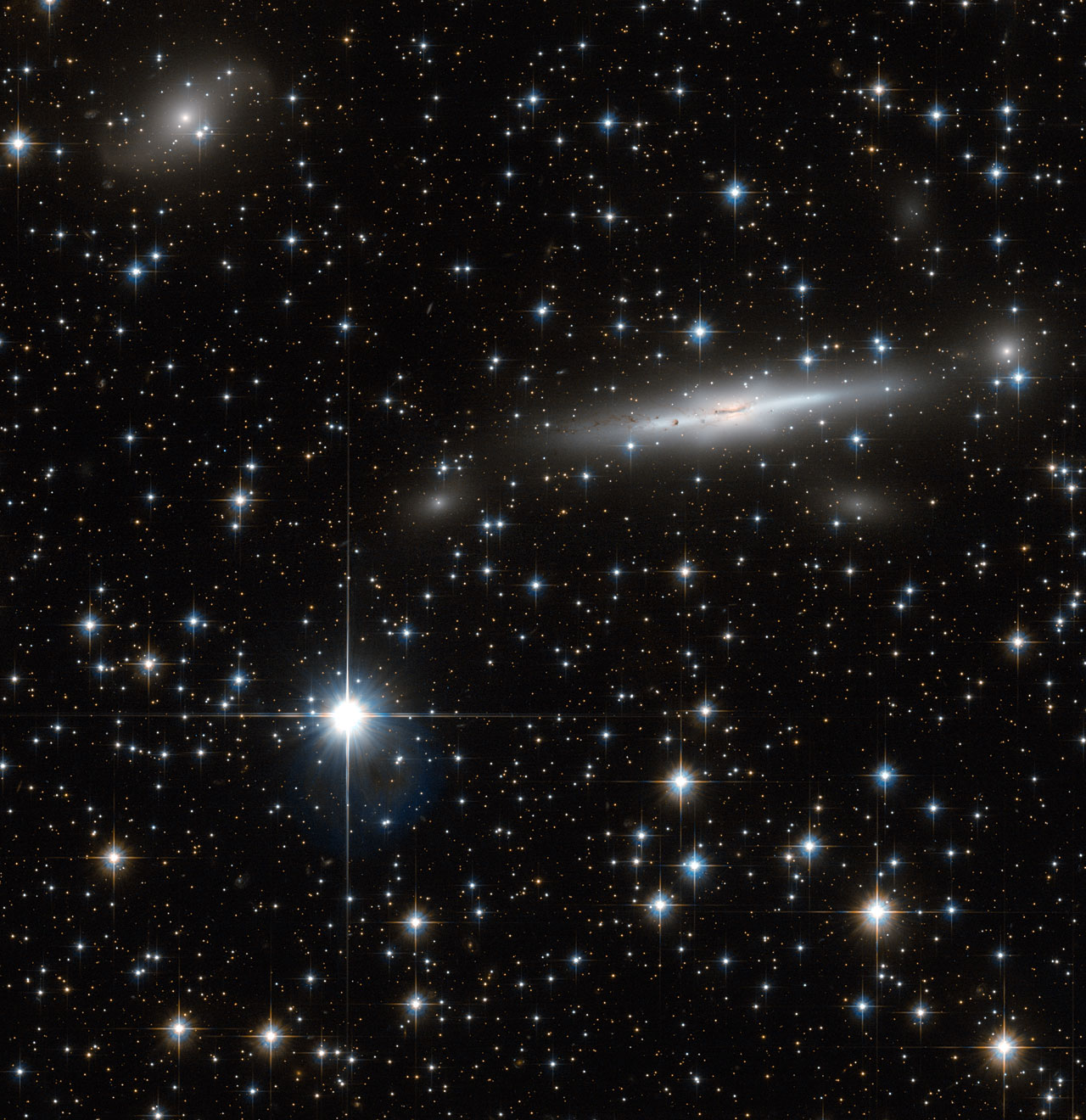
Our galaxy is being pulled toward an unseen mass 150 million light-years away. Obscured by the Milky Way, its nature remains mysterious.
ESA/Hubble Space Telescope & NASA, Public domain, via Wikimedia Commons
A mysterious cosmic flow
Our galaxy is not stationary. The entire Milky Way, along with the Andromeda galaxy and other members of our Local Group, is being pulled through intergalactic space. We are moving at a velocity of roughly 600 kilometers per second (about 2.2 million km/h) toward a specific area of the sky. This motion, first identified through studies of the cosmic microwave background radiation in the 1970s, showed a deviation from the universe's uniform expansion.
The source of this pull is a vast concentration of mass named the Great Attractor. Located between 150 and 250 million light-years from Earth, it lies in the direction of the southern constellations Triangulum Australe and Norma. The gravitational influence of the Great Attractor is immense, affecting the motion of galaxies across a region hundreds of millions of light-years in diameter. The estimated mass required to exert such a pull is on the order of 10 quadrillion solar masses, equivalent to tens of thousands of galaxies like our own.
A group of astronomers in the 1980s, who became known as the "Seven Samurai," systematically mapped the peculiar velocities of galaxies and confirmed the existence and location of this gravitational anomaly. Their work showed that the distribution of galaxies in the universe is uneven, with massive superclusters separated by enormous voids. The Great Attractor is one of these large-scale structures.
Hiding behind the Milky Way
Directly observing the Great Attractor in visible light is exceptionally difficult. Its location puts it squarely behind the plane of our own galaxy, a region packed with stars, gas, and interstellar dust. This area of the sky is so effective at blocking light from more distant objects that astronomers named it the "Zone of Avoidance." This zone obscures about 20% of the extragalactic sky, making optical surveys of the region incomplete.
To peer through this galactic curtain, scientists use other wavelengths of light. X-ray and radio telescopes can penetrate the gas and dust far more effectively than optical telescopes. These observations have revealed that a massive cluster of galaxies, known as the Norma Cluster (or Abell 3627), is near the center of the Great Attractor. The Norma Cluster alone contains thousands of galaxies and has an estimated mass of about 1,000 trillion times that of our Sun.
Even with the discovery of the Norma Cluster, the numbers do not fully add up. The observable mass of this cluster and other nearby structures is does not account for the total gravitational pull experienced by our galaxy and others. This suggests that a significant portion of the Great Attractor's mass is made of dark matter or other structures that are yet to be fully identified. The Great Attractor is the central gravitational point and the central gravitational point of a much larger structure: the Laniakea Supercluster, which contains our Milky Way and about 100,000 other galaxies.
💡Fun Facts
The discovery of the Great Attractor was made by a team of seven astronomers who subsequently became known as the "Seven Samurai."
Due to dark energy and the accelerating expansion of the universe, the Milky Way will likely never actually reach the Great Attractor.
The Great Attractor itself is being pulled toward an even larger concentration of galaxies called the Shapley Supercluster, located about 650 million light-years away.
The term "Zone of Avoidance" was first used in 1878 by English astronomer Richard Proctor, who noted a "Zone of Few Nebulae" along the galactic plane.