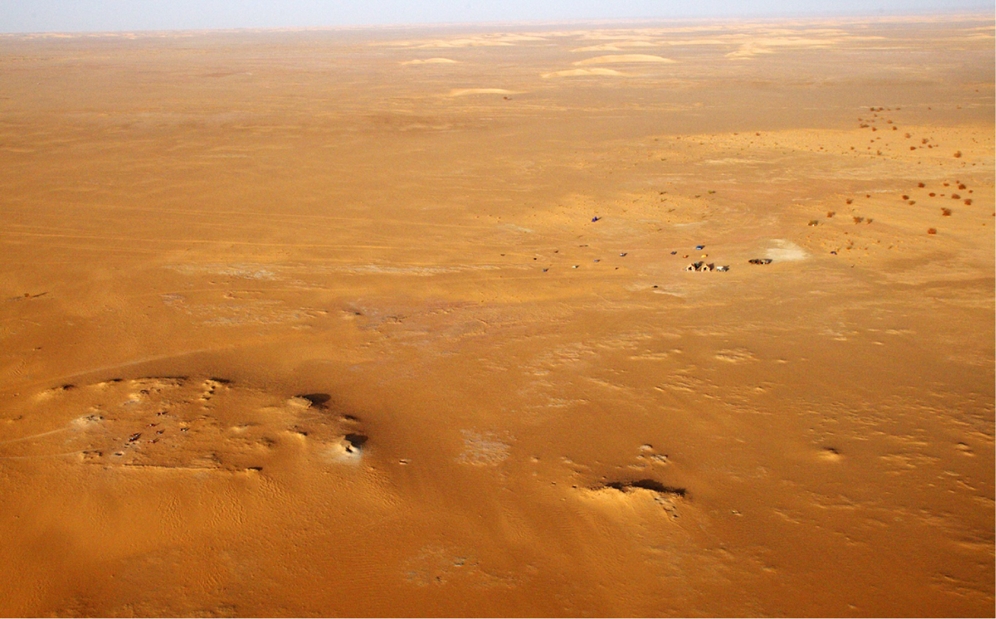
10,000-year-old lakeside cemetery where two completely different populations - separated by 5,000 years - buried their dead in the exact same spot. The lake kept drawing people back even as the climate shifted around them.
Paul C. Sereno, Elena A. A. Garcea, Hélène Jousse, Christopher M. Stojanowski, Jean-François Saliège, Abdoulaye Maga, Oumarou A. Ide, Kelly J. Knudson, Anna Maria Mercuri, Thomas W. Stafford, Jr., Thomas G. Kaye, Carlo Giraudi, Isabella Massamba N'siala, Enzo Cocca, Hannah M. Moots, Didier B. Dutheil, Jeffrey P. Stivers, CC BY 2.5, via Wikimedia Commons
A green Sahara cemetery
In 2000, paleontologists searching for dinosaur fossils in the Ténéré desert stumbled upon something far younger but equally extraordinary: a dense concentration of human skeletons. This was Gobero, the oldest known lakeside cemetery in the Sahara, used for millennia during a wet period known as the African Humid Period. The site contains approximately 200 human burials, providing a record of life when this part of the world was green.
What was once a harsh desert was, for a time, a network of shallow freshwater lakes. Paleolake Gobero, about 3 kilometers in diameter and 3 meters deep, was sustained not by inconsistent rainfall but by groundwater rising to the surface along a geological fault. This stable water source created a persistent haven for fish, crocodiles, hippos, and antelope, which in turn supported human populations for about 5,000 years. The archaeological record at Gobero is divided into four phases, with two main periods of human occupation separated by a long drought. The first settlement belonged to the Kiffian culture, beginning around 9,700 years ago.
Kiffian fishers and Tenerian herders
The Kiffian people were hunter-fisher-gatherers who occupied Gobero from approximately 7700 to 6200 BCE. Analysis of their skeletons shows they were remarkably tall—some males reached 6 feet 8 inches—and powerfully built. Their diet consisted of fish and other lakeside fauna, evidenced by middens full of bones and the presence of barbed bone harpoons and fish hooks. Kiffian burials are distinctive; their bodies were interred in a hyperflexed, or fetal, position, suggesting they may have been bound or wrapped in animal hides or baskets. The dark color of their bones was caused by repeated submersion as the lake's water level rose and fell over the centuries.
Around 6200 BCE, a severe arid phase forced the Kiffians to abandon the area. The drought may have lasted for a millennium. When humid conditions returned around 5200 BCE, a new, physically distinct group of people arrived: the Tenerians. The Tenerians were shorter and more gracefully built. Their culture was different; they were nomadic herders who brought domesticated cattle to the region. Tenerian burials show more variation in posture, often semi-flexed, and frequently include grave goods. Archaeologists have found individuals buried with ivory and shell ornaments, projectile points, and even pottery. One burial is that of a woman and two children, interred together with their hands entwined, possibly decorated with flowers, based on pollen evidence found in the grave.
💡Fun Facts
The site was discovered by a team led by paleontologist Paul Sereno, who was originally searching for dinosaur remains.
One young Tenerian girl was found buried wearing a bracelet carved from a hippopotamus tusk.
A Kiffian man, dating to nearly 7,000 years ago, was buried with the large upper shell of a mud turtle placed under his pelvis.
The Kiffian people were exceptionally tall, with some individuals standing well over 6 feet.
Not applicable; the site is in a remote, unprotected desert location.
Admission
Not applicable.
Accessibility
The site is located deep within the Ténéré desert, one of the most inaccessible parts of the Sahara. Reaching it requires a specialized multi-day 4x4 expedition with experienced guides. The terrain is extremely harsh, with sandstorms and intense heat.