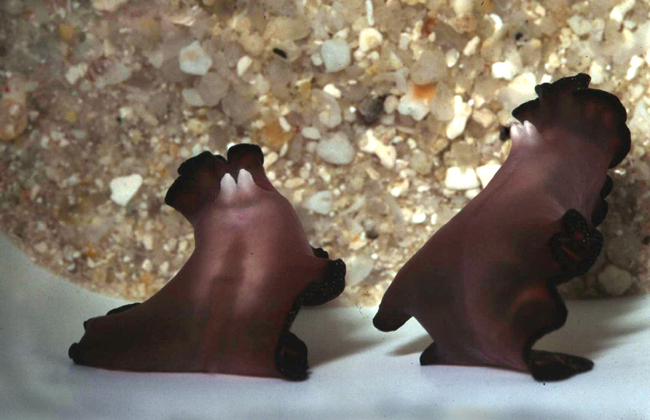
A tiny hermaphroditic flatworm where individuals fight to inseminate each other while avoiding being inseminated. It's become a model for studying sexual conflict and traumatic insemination.
Photo courtesy of Nico Michiels., CC BY 2.5, via Wikimedia Commons
A Duel of Hermaphrodites
In the waters of the Adriatic, a bizarre duel takes place. The combatants are polyclad flatworms, such as Pseudoceros bifurcus, soft-bodied invertebrates that grow up to about five centimeters long. These creatures are simultaneous hermaphrodites, meaning each individual possesses both male and female reproductive organs. When two flatworms meet, they engage in behavior known as "penis fencing." Each worm extends two sharp, dagger-like penises (called stylets) from its underside and attempts to stab its partner anywhere on the body.
The goal is to inject sperm and become the father, while avoiding being stabbed and forced into the role of the mother. This is not a quick ritual; the battles can last for up to an hour. The "winner" is the first to successfully pierce the other's skin and inject its sperm. The injected sperm is then absorbed through the recipient's tissue to fertilize its eggs. This violent method of reproduction is called traumatic insemination or hypodermic insemination.
The Evolutionary Arms Race
The underwater fencing match results from sexual conflict. For these flatworms, the energetic cost of producing eggs and mothering offspring is far greater than the cost of producing sperm. This asymmetry drives the intense competition to assume the male role. The "loser" of the duel bears the full maternal cost.
This behavior drives evolution. It creates selective pressure for both offensive and defensive traits. Worms may evolve more effective, sharper stylets for injection, while simultaneously developing tougher skin or better evasive maneuvers to avoid being inseminated. The act of traumatic insemination, piercing the skin to inject sperm directly into the body cavity, has evolved independently at least nine times in different flatworm groups. This reproductive strategy bypasses the partner's female reproductive tract entirely, ensuring the sperm has a direct route towards the eggs. The bright colors of many of these flatworms, which make them visible to divers, warn predators about their toxicity.
💡Fun Facts
Each flatworm fences with a pair of penises.
Some flatworm species can regenerate completely even if their head is severed.
The "loser" of the duel bears the entire energetic cost of developing eggs and becoming a mother.
The flatworm's scientific phylum, Platyhelminthes, also includes parasitic tapeworms and flukes.