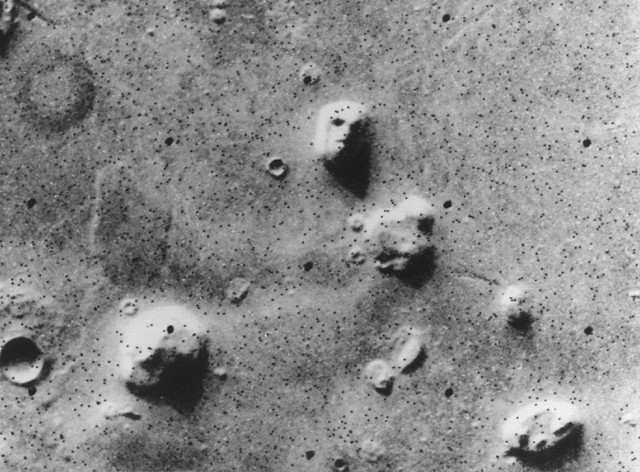
An accidental discovery
On July 25, 1976, NASA's Viking 1 orbiter was busy scouting for a safe landing site for its sister craft, Viking 2. While photographing the northern latitudes of Mars, it captured frame 35A72. Buried within the image, in a region called Cydonia, was a rock formation that looked uncannily like a humanoid face. The mesa, a flat-topped, steep-sided hill, measured approximately 3 kilometers (1.9 miles) long and 1.5 km (0.9 miles) wide. Shadows cast by the low sun angle—about 20 degrees above the horizon—created the illusion of eyes, a nose, and a mouth.
NASA scientists correctly identified the feature as a natural landform, releasing the image with a caption noting its resemblance to a human head was a trick of light and shadow. The image quickly entered the public imagination, fueling speculation about ancient Martian civilizations. The effect is an example of a psychological phenomenon called pareidolia, the human brain's tendency to perceive familiar patterns, especially faces, in random stimuli. This cognitive shortcut is what allows us to see animals in clouds or a "man in the moon." The original Viking 1 image was also speckled with data transmission errors, known as bit errors, which coincidentally increased the "eye" and "nostril" features, further solidifying the illusion.