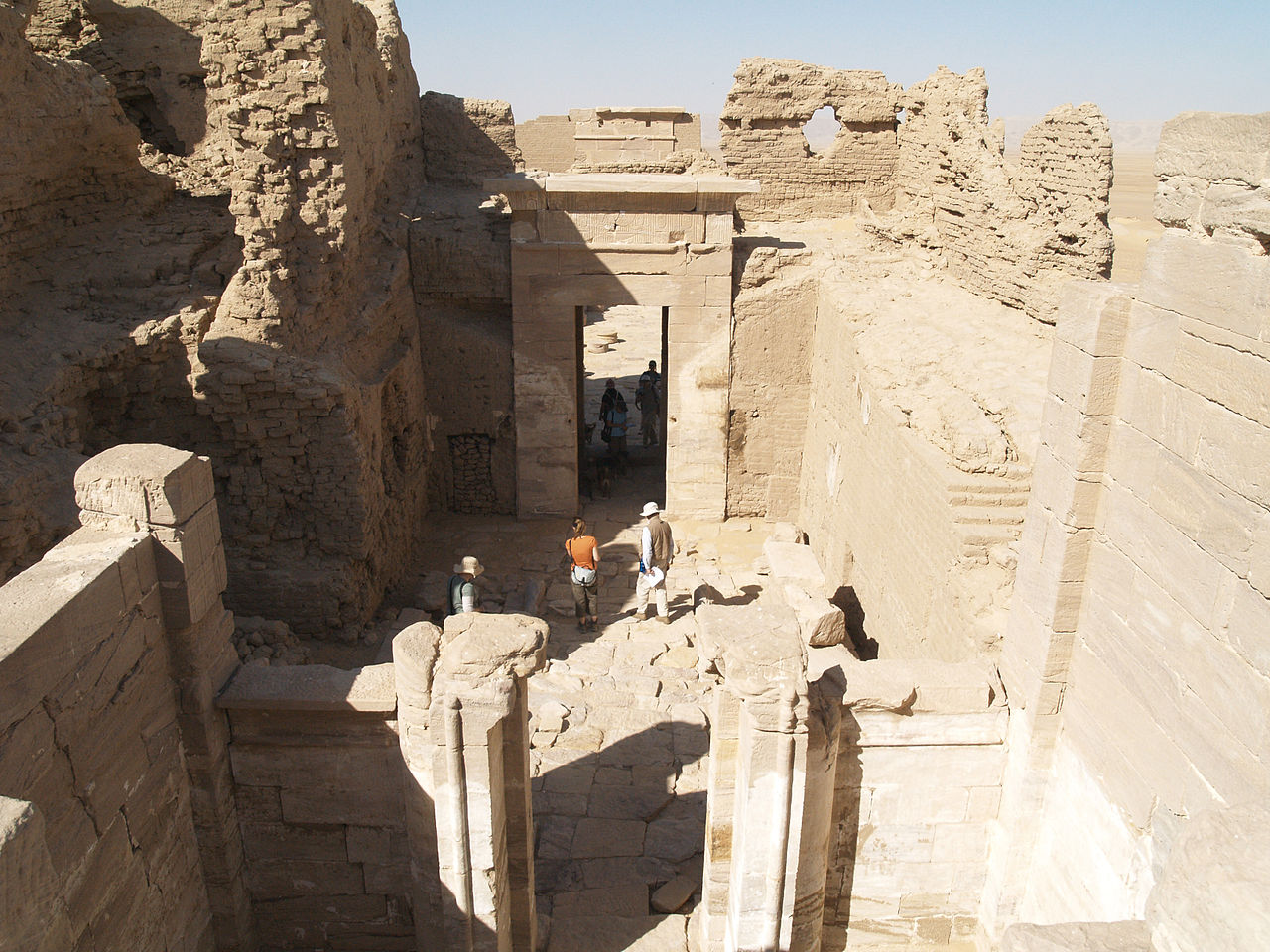
A 1,700-year-old frontier fort marking where Roman civilization met Saharan raiders. Soldiers stationed here watched the desert horizon for threats that could materialize from the sand at any moment.
isawnyu, CC BY 2.0, via Wikimedia Commons
A watchtower on the sand sea
The Roman fort of Dush, known in antiquity as Kysis, stands on a hill 79 meters above sea level in Egypt's Kharga Oasis. This position was a strategic choice, giving the garrison a commanding view of the surrounding desert. The location was no accident; it sits at the junction of five ancient desert tracks, including the important Darb al-Dush which connected the oasis directly with Nile valley cities like Esna and Edfu. The massive mudbrick walls, which still rise to between 6 and 12 meters in places, enclosed a rectangular military installation. Archaeological evidence suggests the structure has a complex history, with the Romans expanding upon an earlier fortress that may date to the Ptolemaic or even the Persian period.
Inside the crumbling walls, excavations have revealed barracks and other structures typical of a Roman outpost. The fort was a military base; it protected the town of Kysis and its cultivated lands. The entire complex was an important control point for the caravans and trade moving through this remote part of the Roman Empire. Analysis of the site shows it was abandoned sometime after the fourth century AD, possibly when its wells dried up.
Temple life and buried gold
Abutting the fortress's eastern side is a well-preserved sandstone temple. Initially dedicated to the Egyptian god Osiris, its worship was later syncretized with the Greco-Roman deity Serapis, and it also honored the goddess Isis. Construction began under the emperor Domitian, with later additions and decorations by Trajan and Hadrian in the 1st and 2nd centuries AD. A dedicatory inscription from Trajan, dated to 116 AD, survives on a monumental stone gateway. The main temple building measures approximately 7.5 by 15.5 meters and contains a pillared hall, a sanctuary with a vaulted roof, and several side chambers.
In 1989, archaeologists from the French Institute of Oriental Archaeology (IFAO) made a spectacular discovery. Concealed within a large pottery jar hidden by masonry, they found what is now called the "Dush Treasure". This hoard of golden religious artifacts included a crown depicting Serapis, complex bracelets, and necklaces. The craftsmanship of these 2nd-century AD items shows religious practices and wealth that passed through this distant outpost. Also found nearby were a gilded statuette of Isis and a small bronze figure of her son Horus dressed as a Roman legionary.
💡Fun Facts
The fort's ancient name was Kysis.
Thousands of ostraca—inscribed pottery sherds—have been found, serving as ancient receipts, supply lists, and private letters for the garrison.
The "Dush Treasure," a hoard of golden religious objects from the 2nd century AD, was found hidden inside a ceramic jar in 1989.
The site was strategically placed at the intersection of five caravan routes, controlling trade and movement into the Nile Valley.