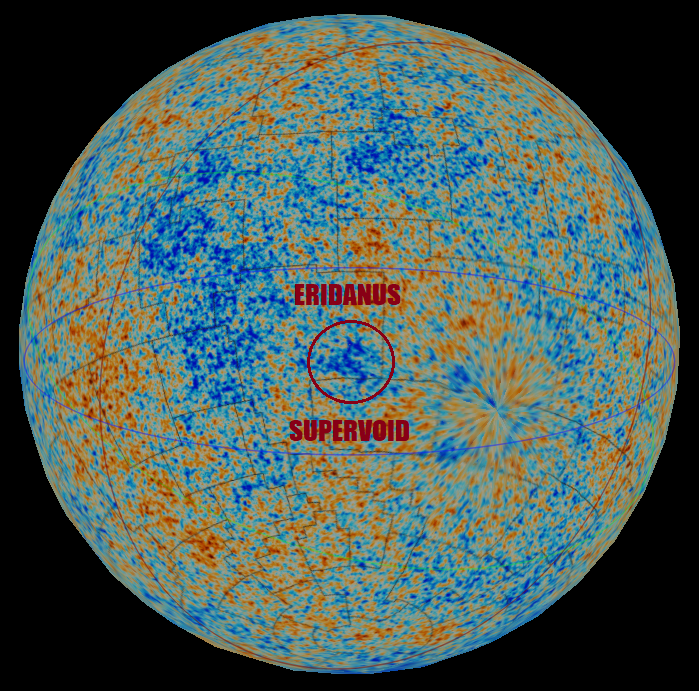
An anomalously cold region in cosmic microwave background, possibly the largest structure in the universe. No model fully explains its size or coldness.
Piquito veloz´s screenshot. Labeled by Piquito veloz, CC BY-SA 4.0, via Wikimedia Commons
A chill from the dawn of time
The Cosmic Microwave Background (CMB) is the oldest light in the universe, a faint afterglow from the Big Bang when the cosmos was just 380,000 years old. This radiation fills all of space, maintaining a near-perfectly uniform temperature of 2.725 Kelvin. In 2004, data from NASA's Wilkinson Microwave Anisotropy Probe (WMAP) revealed a shocking anomaly: a vast patch of sky in the direction of the constellation Eridanus that was significantly colder than the rest.
Known as the CMB Cold Spot, this region is, on average, 70 microkelvins (0.00007 K) cooler than the background, with its coldest points dipping to 140 microkelvins below average. This may seem small, but typical CMB fluctuations are only around 18 microkelvins. The spot is also enormous, spanning about 5 degrees of the sky. The probability of such a large, cold patch appearing randomly from the quantum fluctuations of the early universe is extremely low. Its existence was later confirmed with greater precision by the European Space Agency's Planck satellite, ruling out instrumental error.
A giant void or a cosmic collision?
Two main categories of theories attempt to explain the Cold Spot's existence. The leading, though incomplete, explanation involves a massive cosmic structure called the Eridanus Supervoid. This is a vast region of space, estimated to be 1.8 billion light-years across, that is relatively empty, containing about 30% less matter than the cosmic average. It sits between us and the CMB, about 3 billion light-years away. According to the Integrated Sachs-Wolfe (ISW) effect, as photons from the CMB travel through an expanding supervoid, they lose a net amount of energy. This energy loss makes the CMB light from that direction appear slightly colder. While the Eridanus Supervoid exists and is aligned with the Cold Spot, studies show it is not large or empty enough to account for the entire temperature drop through the ISW effect alone.
This discrepancy leaves room for more exotic explanations. One hypothesis suggests the spot is a "cosmic texture," a type of topological defect left over from a phase transition in the very early universe. Another, more speculative idea, posits that the Cold Spot is a cosmic "bruise," the lingering imprint of a collision between our universe and another "bubble" universe. In this multiverse scenario, contact between two universes in the distant past could have left a detectable, disk-like signature on the CMB. While this remains unproven, the failure of the supervoid model to fully explain the data keeps these more unconventional ideas in play.
💡Fun Facts
The Eridanus Supervoid is one of the largest structures ever discovered, spanning a distance it would take light 1.8 billion years to cross.
The probability of a cold spot this large and cold appearing by chance in the standard model of cosmology is estimated to be as low as 1 in 2000.
A "void" in cosmology does not mean perfect emptiness; it is a region with a significantly lower density of galaxies and dark matter than the universal average.
The Cold Spot was first detected by the WMAP satellite and later confirmed by the Planck satellite, which mapped the CMB with higher resolution.