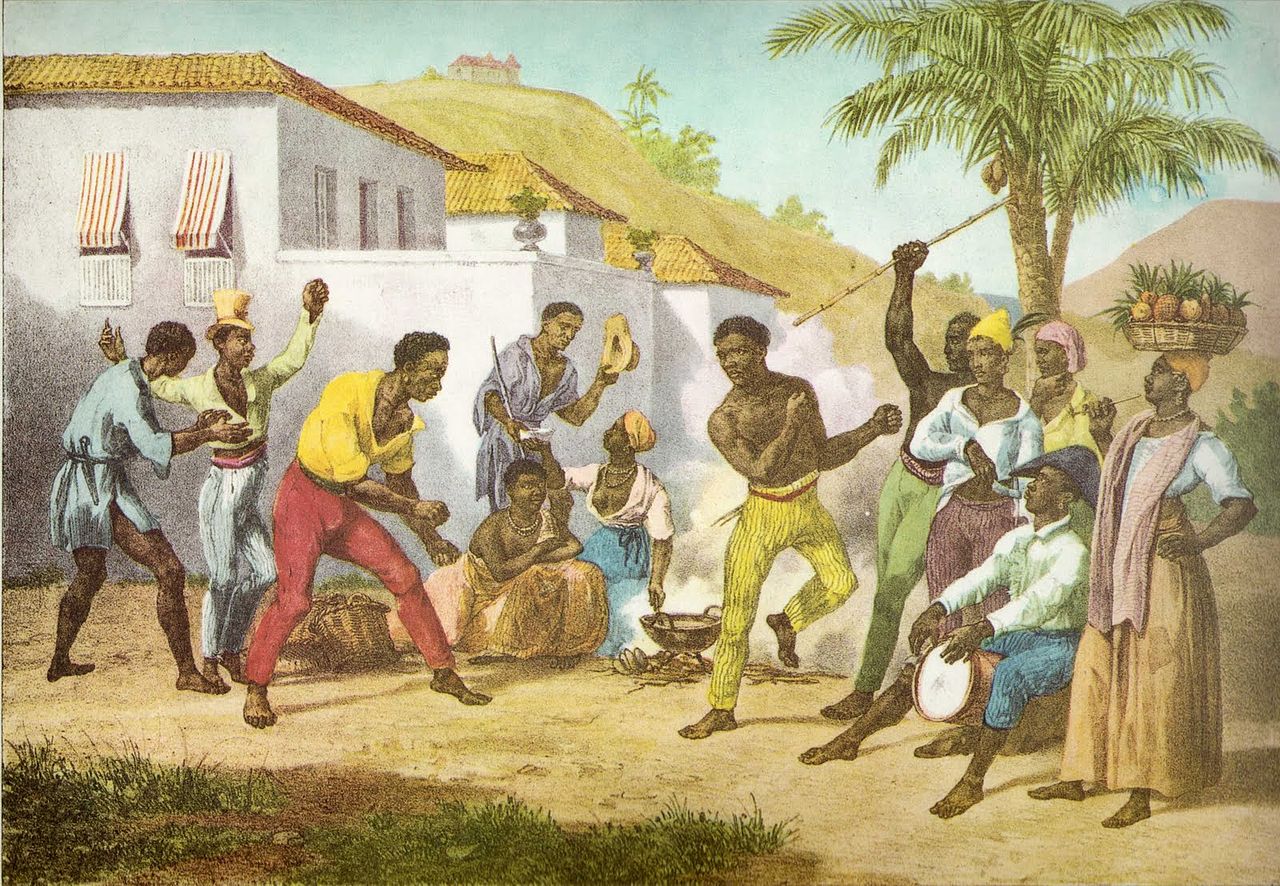
A martial art disguised as dance, developed by enslaved Africans. The roda (circle) creates musical feedback loops where rhythm controls movement. Players communicate through a call-and-response of bodies and instruments.
Johann Moritz Rugendas, Public domain, via Wikimedia Commons
The Roda as a Sonic Laboratory
The capoeira roda (circle) is an acoustic arena where music directs physical action. Practitioners form a circle of bodies that functions as a space for a physical game between two players and as a human amplifier for the music. The musical section, called the bateria, leads the event. Its primary instrument is the berimbau, a single-stringed musical bow. The berimbau player is the ultimate authority in the roda, controlling the tempo, the style of the game, and even starting and stopping the interactions.
This control is exerted through specific rhythms, or toques. The berimbau produces three primary sounds: a low open tone (dom), a high-pitched tone (ding), and a buzzing sound (tsh). Combinations of these three sounds create the toques. Each toque calls for a different style of game. For example, the Angola toque dictates a slow, low-to-the-ground game of cunning and strategy. In contrast, São Bento Grande de Regional is a fast, upright game featuring acrobatic kicks and takedowns. Another toque, Cavalaria, historically served as a warning that police were approaching, at which point the game would morph into a simple dance to hide its martial nature. The players must listen and respond to the berimbau's commands, creating a direct feedback loop between sound and movement.
A Call-and-Response System
The entire roda operates on the principle of call-and-response, a structure common in African diasporic music. This extends beyond the lead singer chanting a verse and the chorus responding. The bateria instruments—which also include the atabaque (drum) and pandeiro (tambourine)—initiate a musical call. The two players inside the circle answer this call with their bodies, engaging in a physical dialogue. Their movements, in turn, become a call to their opponent, who must respond with a defensive or counter-offensive move.
This system creates a complex conversation. The music calls the bodies to move, and the moving bodies influence each other. The energy of the players can even call for a change from the musicians, who might alter the toque to match the intensity of the game. Ethnomusicologists study this interaction as a form of embodied music, where the human body is both a receiver and a generator of rhythmic information. The development of capoeira in Bahia by enslaved Africans from the 16th century onward was a means of cultural and physical resistance. Banned for much of its history, the practice was legitimized in the 1930s through the work of masters like Mestre Bimba, who founded the first official school in 1932. On November 26, 2014, the capoeira circle was recognized by UNESCO as an Intangible Cultural Heritage of Humanity.
💡Fun Facts
The word "capoeira" is thought to refer to the low-vegetation areas in the Brazilian interior where escaped slaves would hide and practice their fighting skills.
Mestre Bimba, a key figure in modern capoeira, named his style *Luta Regional Baiana* (Regional Fight from Bahia) because the term "capoeira" was still illegal in the 1930s.
The *berimbau* string is often taken from the steel belt of a used car tire.
Mestre Pastinha, the father of the traditional Capoeira Angola style, opened his first school in 1941 to preserve the art's older forms.
Many schools (academies) in Salvador's historic Pelourinho district offer drop-in classes or demonstrations, typically in the evenings. It is best to contact a specific academy for their schedule.
Admission
A single drop-in class can cost around R$50 (approx. $10 USD), while others may have different rates for visitors. Public rodas, such as those at the Forte de Santo Antônio Além do Carmo, are often free to watch.
Accessibility
The historic center of Salvador has many cobblestone streets and hills, which can be challenging for mobility. Academies are often in historic buildings which may have stairs.