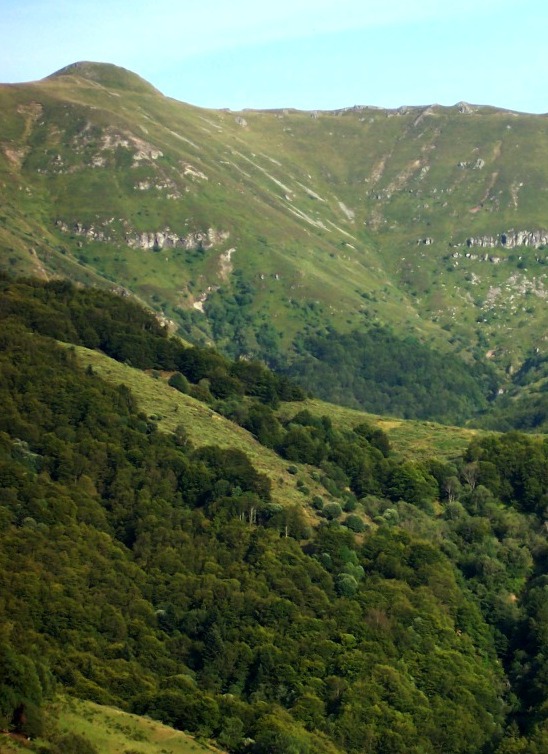
Europe's largest stratovolcano, now so eroded you'd never know it existed. Seven million years ago it towered higher than Mont Blanc. When it collapsed, glaciers carved the caldera into rolling green hills. Only radiating valleys reveal the former volcanic giant.
No machine-readable author provided. B.navez assumed (based on copyright claims)., CC BY-SA 3.0, via Wikimedia Commons
The Invisible Mountain
The rolling green landscape of Cantal is a ghost. Beneath the pastures lies the deeply eroded base of Europe's largest stratovolcano. Active between 13 and 3 million years ago, this giant was built in successive phases. The main period of cone-building activity occurred between 8.5 and 7 million years ago, constructing a volcano that may have reached an altitude between 3,500 and 4,000 meters. At its base, the volcano has a diameter of 50 to 70 kilometers, covering a surface area of about 2,700 square kilometers—far larger than Mount Etna.
The volcano's life was violent. Its construction involved lava flows and massive explosive eruptions that produced trachyandesite, trachyte, and phonolite. The sheer weight and height of the main cone led to multiple catastrophic collapse events. These collapses created enormous debris avalanches that spread outwards, forming a vast apron of volcanic material around the central mountain. This cycle of construction and destruction happened repeatedly over a two-million-year period. The last volcanic activity in the area occurred around 2.9 million years ago, forming the basanite rock of what is now the Plomb du Cantal.
Carved by Ice
After the volcano fell silent, a different force began to reshape the land: ice. During the Quaternary period, which began around 2.6 million years ago, glaciers covered the collapsed and weathered mountain. These rivers of ice flowed down the volcano's flanks, following the paths of least resistance. They carved out the pre-existing weaknesses in the volcanic structure, gouging deep, U-shaped valleys that radiate from the center of the massif like the spokes of a wheel. Today, around 20 such valleys, including the Cère, Alagnon, and Jordanne, define the landscape.
This intense glacial erosion stripped away thousands of meters of rock, exposing the volcano's inner structure. The remaining high points are not independent mountains; they are the most resistant remnants of the original stratovolcano. Peaks like the Plomb du Cantal (1,855 meters), Puy Mary (1,783 meters), and Puy Griou (1,690 meters) are the hard cores—solidified lava domes and necks—that withstood the grinding power of the ice. Between these peaks lie distinctive triangular plateaus called "planèzes," which are the remnants of thick, ancient basalt flows that once covered the volcano's slopes. What appears to be a mountain range is the excavated heart of a single, colossal volcano.
💡Fun Facts
The Cantal massif is the largest stratovolcano in Europe, with a diameter up to 70 kilometers.
Some geologists estimate its original height may have been as much as 4,000 meters, taller than any peak in the Alps.
The distinctive star-shaped pattern of valleys was carved by glaciers flowing down the slopes of the collapsed volcanic cone.
The current highest peak, Plomb du Cantal, is composed of basanite from one of the final eruptions, around 2.9 million years ago.
The park and hiking trails are accessible 24/7, but are subject to weather conditions, especially snow from November to April.
Admission
Free to enter the Parc Naturel Régional des Volcans d'Auvergne and access hiking trails. Some specific attractions or parking areas may have fees.
Accessibility
The terrain is mountainous. Trails vary from easy walks to strenuous multi-day hikes like the GR 400. The summit of Plomb du Cantal is accessible via cable car from the Super Lioran resort during its operating seasons.