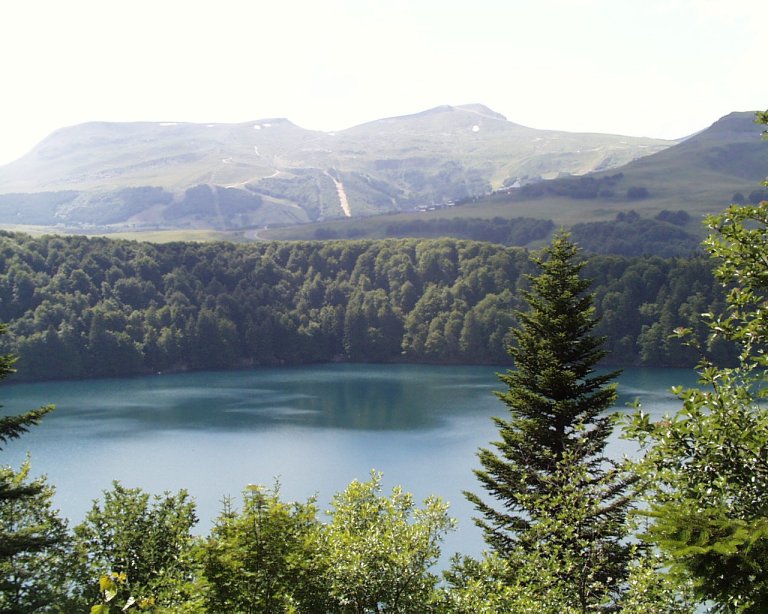
A Violent Birth
Lac Pavin occupies a crater—a maar—blasted into the French landscape around 6,900 years ago. It is the youngest volcanic structure in mainland France. The formation was the result of a phreatomagmatic eruption, a violent event that occurs when rising magma meets groundwater. The instant vaporization of the water created a massive explosion, estimated to have ejected 75 million cubic meters of material. Traces of this single, powerful eruption have been found in the sediments of Lake Geneva, hundreds of kilometers away. The resulting crater is a near-perfect circle, about 800 meters in diameter, which subsequently filled with water. At its deepest point, the lake is 92 meters deep, making it the most deep in the Auvergne region.
A Permanently Layered Lake
Lac Pavin is a rare type of lake known as meromictic, meaning its water layers do not mix. Most lakes are holomictic, turning over their water at least once a year, which circulates oxygen and nutrients. Lac Pavin is permanently stratified into two distinct zones. The upper layer, down to about 60 meters, is called the mixolimnion. It behaves like a normal lake, with oxygenated water that supports fish like Arctic char and a population of zooplankton.