The Engineer in the Undergrowth
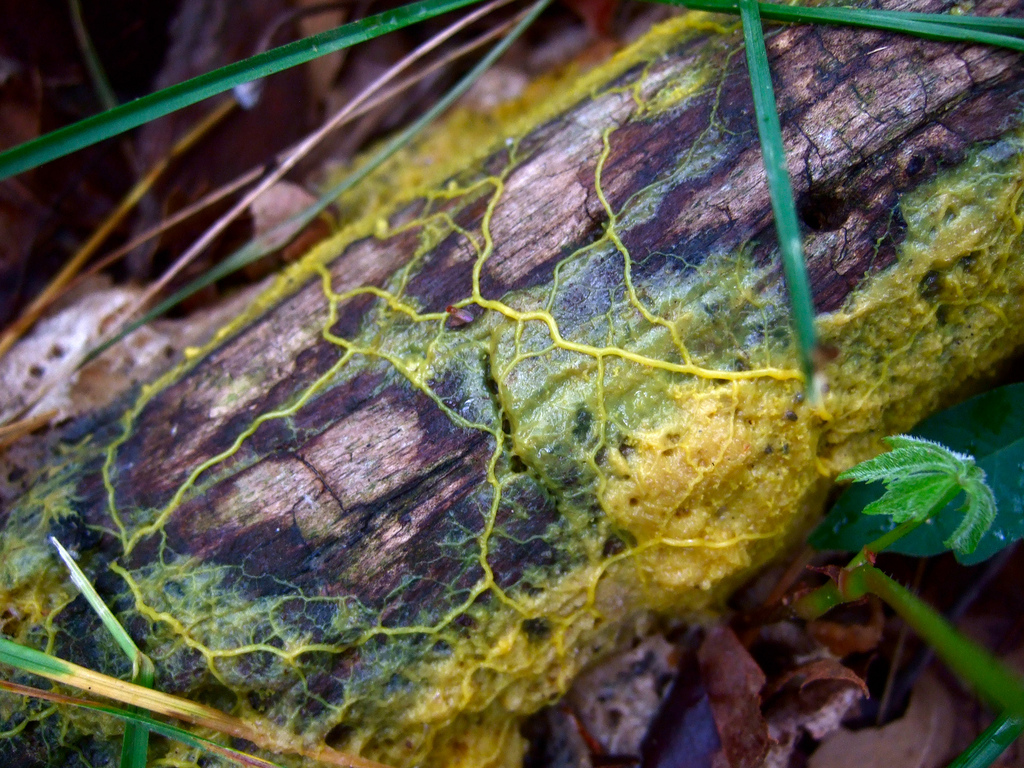
The organism Physarum polycephalum is not a plant, animal, or fungus. It is a myxomycete, or a plasmodial slime mold, that lives in shady and moist habitats like forest floors. The visible, active stage of its life is a plasmodium: a single, giant cell containing millions of nuclei that can grow to cover several square meters. This bright yellow mass moves by extending tube-like structures and pushing the cytoplasm inside, a process called cytoplasmic streaming. Each part of the plasmodium rhythmically expands and contracts to circulate nutrients and chemical signals throughout the entire cell body. This decentralized network allows the organism to forage for its food of bacteria and fungal spores, reacting to local stimuli to move toward food and away from light or repellents.
This simple organism exhibits behaviors that challenge definitions of intelligence. It can solve mazes, consistently finding the most direct route between two food sources. To do this, it first explores every possible path, then retracts from dead ends and strengthens the protoplasmic tube that forms the shortest connection. It also possesses a form of memory. By leaving a trail of slime, it avoids re-exploring areas it has already searched. Experiments in 2008 demonstrated it can anticipate periodic events; after being exposed to cold pulses every 60 minutes, the slime mold continued to slow its activity at 60-minute intervals even after the pulses stopped.
A Bio-Inspired Transit System
In a 2010 experiment published in the journal Science, a team led by Toshiyuki Nakagaki at Hokkaido University tested Physarum's network-building capabilities against a known efficient design: the Tokyo-area rail system. They arranged 36 oat flakes, a favorite food source, on a petri dish in a pattern that mirrored the locations of Tokyo and its surrounding cities. The slime mold was placed at the "Tokyo" flake and allowed to grow.
Initially, the plasmodium spread out, exploring the entire surface. Within about 26 hours, it had formed a network of tubes connecting all the oat flakes. The organism then refined this network, strengthening the most-used pathways and removing redundant connections. The final structure was strikingly similar to the actual Tokyo rail network. When analyzed, the slime mold's network showed a comparable efficiency and cost (measured by total tube length) to the human-engineered system. The slime mold's design also demonstrated a greater fault tolerance, meaning it had more redundancy to handle a connection being broken. The entire process was achieved through simple, local rules of growth and reinforcement, without any central planning.