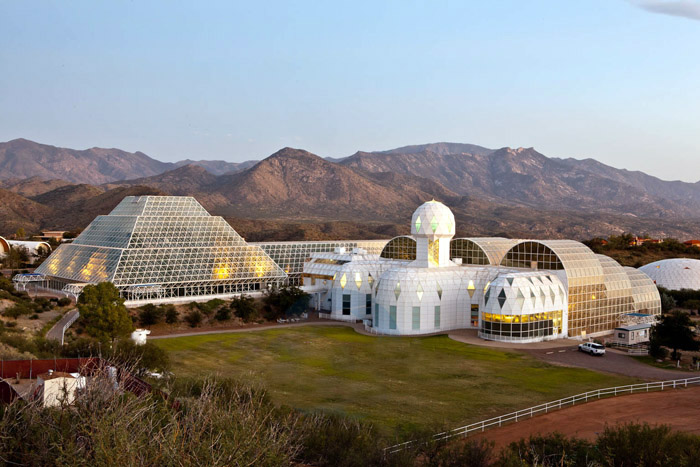
A 3-acre sealed glass structure in Arizona where eight people tried to live in a self-contained ecosystem from 1991 to 1993. Oxygen levels crashed, crops failed, and the crew split into factions, revealing how hard it would be to build habitats on other planets.
Johndedios, CC BY 3.0, via Wikimedia Commons
A world under glass
Constructed between 1987 and 1991, Biosphere 2 is the largest closed ecological system ever built. The 3.14-acre glass and steel structure in Oracle, Arizona, was designed to test the viability of self-sustaining ecosystems for potential space colonization. Inside its sealed environment, which contains a total volume of approximately 200,000 cubic meters, engineers created seven distinct biomes. These included a 1,900-square-meter rainforest, an 850-square-meter ocean with a coral reef, mangrove wetlands, a savanna grassland, and a fog desert. Two artificial biomes were also built: a 2,500-square-meter agricultural area for food production and a human habitat with living quarters and labs.
The project's first and most famous mission began on September 26, 1991. A crew of eight people, known as "biospherians," sealed themselves inside with over 3,800 species of plants and animals, intending to remain for two years with no material inputs from the outside world. The goal was to live entirely on the food they grew, breathe the air recycled by plants, and manage their own waste. The structure itself was an engineering feat, built to be almost perfectly airtight. Its atmospheric leakage rate was less than 10% per year, making it more tightly sealed than the Space Shuttle.
The oxygen mystery
Sixteen months into the two-year experiment, a serious problem emerged: the oxygen level inside was steadily dropping. It fell from the normal atmospheric concentration of 20.9% to a dangerously low 14.5%—an oxygen level similar to that at an altitude of over 13,000 feet. Crew members experienced fatigue and sleep apnea, struggling to finish sentences without taking a breath. The cause was not immediately clear. While respiration consumes oxygen, the corresponding amount of carbon dioxide was not building up in the atmosphere as expected.
The solution to the mystery was found in the facility's massive concrete structures. Microbes in the nutrient-rich soil were breaking down organic matter and releasing large amounts of carbon dioxide, a process that also consumed oxygen. But as the CO2 was released, it chemically reacted with exposed concrete, forming calcium carbonate and trapping carbon and oxygen in the walls. This unforeseen chemical reaction, called carbonatation, starved the atmosphere of oxygen. To ensure the crew's safety, pure oxygen was pumped in from the outside in January 1993. Other problems affected the mission: crop yields were low, and the crew was constantly hungry. Most of the vertebrate species and all of the pollinating insects died off, while cockroaches and ants thrived.
The University of Arizona took over management of the facility in 2007 and acquired full ownership in 2011. Biosphere 2 is an active earth science research facility. Scientists use the contained biomes to conduct large-scale experiments on the effects of climate change, such as how rainforests cope with drought and how coral reefs respond to ocean acidification.
💡Fun Facts
The name "Biosphere 2" was chosen because "Biosphere 1" is planet Earth.
During the first mission, the crew managed to produce about 80% of their own food.
A second, shorter mission began in March 1994 but ended prematurely after management disputes and an incident where two former crew members broke the airlock seals.
Steve Bannon, a future White House Chief Strategist, was brought in as the facility's CEO in 1994 to resolve financial issues.