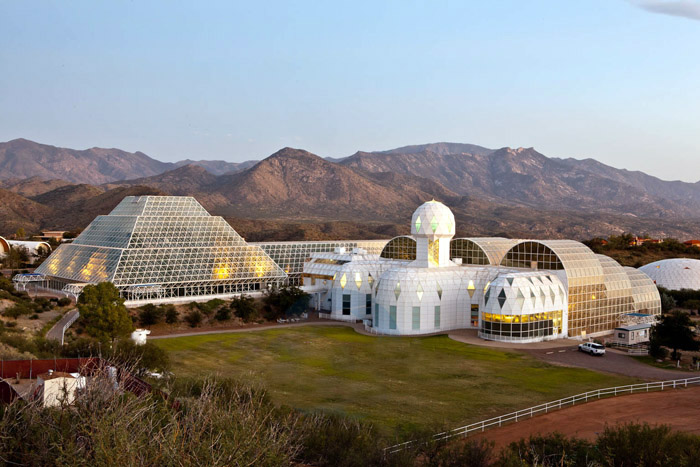
Eight people sealed themselves in a 3.14-acre glass dome for two years, only to discover that managing a closed ecosystem is far harder than expected - oxygen plummeted and they nearly suffocated.
Johndedios, CC BY 3.0, via Wikimedia Commons
A world under glass
On September 26, 1991, eight researchers stepped inside a 3.14-acre glass and steel enclosure in Oracle, Arizona, for a two-year mission. Their new home, Biosphere 2, contained five miniaturized biomes: a tropical rainforest, a mangrove wetland, a savanna grassland, a coastal fog desert, and a 2,600-cubic-meter "ocean" with a coral reef. The $150 million project was designed as a materially-closed ecological system, a test for supporting human life on other planets. Inside, the "Biospherians" were to grow all their own food, recycle their waste, and breathe air produced by the 3,800 species of plants and animals sealed in with them.
The desert biome was specifically modeled on a coastal fog desert, similar to those in Baja California. It was designed to study how arid ecosystems adapt to limited rainfall and changing water availability. The grand experiment quickly encountered system-wide problems that no single biome could escape.
When the air runs out
Within months, it became clear something was wrong. The oxygen levels inside Biosphere 2 were steadily dropping. Over 16 months, the atmospheric oxygen concentration fell from a normal 20.9% to a dangerously low 14.2%—the equivalent of living at an elevation of 15,000 feet. The crew experienced fatigue and sleep apnea; and simple tasks became difficult. The cause was a mystery until later analysis revealed a two-part problem. Microbes in the organically fertile soil were consuming oxygen and releasing large amounts of carbon dioxide at a much higher rate than anticipated. Concurrently, this excess CO2 was reacting with exposed concrete in the structure's foundation, forming calcium carbonate and effectively trapping the oxygen atoms.
Other systems failed as well. Most pollinating insects died off, and invasive species like cockroaches and "crazy ants" thrived. The desert biome, intended to be arid, suffered from excess condensation and became overgrown with grasses. The mission required external intervention; oxygen was pumped into the facility to allow the crew to complete their two-year stay.
Today, Biosphere 2 is operated by the University of Arizona as a major Earth systems science research facility. The desert biome is used for controlled experiments, studying how desert plants and soil microbes respond to changes in moisture and temperature. Researchers also use the larger facility for projects like the Landscape Evolution Observatory (LEO), where three massive, sensor-laden hillslopes show how water moves through landscapes to better predict the effects of climate change.
💡Fun Facts
The agricultural area, which produced 83% of the crew's food, was an efficient farm in the world by output per unit area.
The crew’s low-calorie, nutrient-dense diet caused them to lose an average of 16% of their body weight in the first year.
The name "Biosphere 2" recognizes Earth as the first biosphere.
The facility has two massive expansion chambers called "lungs" to prevent the glass from shattering due to air pressure changes from daytime heating.