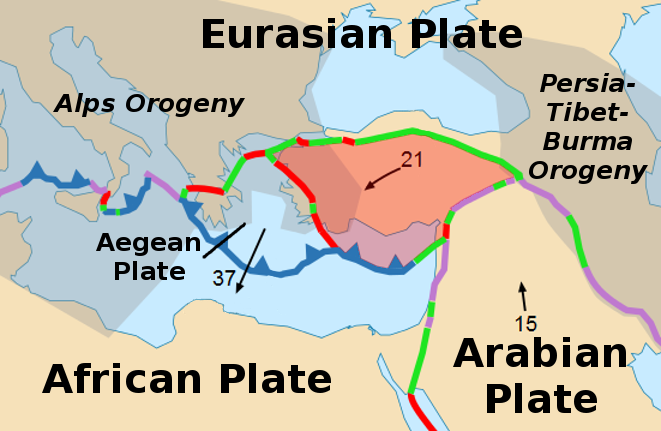
A Tectonic Squeeze Play
The entire nation of Turkey rests on a small tectonic plate called the Anatolian Plate, and it is being squeezed out to the west. This geological escape is driven by immense continental forces. To the east, the Arabian Plate pushes relentlessly northward into the massive Eurasian Plate. Caught in the middle, the Anatolian Plate has nowhere to go but sideways, sliding west along two major fault lines. This westward motion is a measured reality. A dense network of continuously operating GPS stations, part of the Turkish National Fundamental GPS Network (TNFGN), tracks this movement with millimeter precision. The data shows Anatolia moving west at a rate of 20-25 millimeters per year—about the speed at which a human fingernail grows.
This westward escape is further encouraged by a process occurring to the southwest in the Mediterranean. Here, the African Plate is subducting, or diving beneath, the Anatolian and Aegean plates at the Hellenic Trench. This subduction creates a "pulling" force, a phenomenon known as slab rollback, which accelerates Anatolia's movement west and causes the crust in the Aegean Sea to stretch and thin.
A March of Earthquakes
The primary northern boundary of this movement is the North Anatolian Fault (NAF), a 1,500-kilometer-long, right-lateral strike-slip fault that is remarkably similar in scale and type to California's San Andreas Fault. This fault accommodates the immense stress from the plate's westward motion, but it does not release it uniformly. Instead, it ruptures in segments, creating a predictable pattern. Over the 20th century, seismologists observed a clear westward progression of major earthquakes along the NAF.
This sequence began with the devastating 1939 Erzincan earthquake, which had a magnitude of approximately 7.8. In the years that followed, the stress from this rupture appeared to load the adjacent fault segment to the west, triggering the next major event. A grim domino effect unfolded across the decades:
- 1942 Niksar-Erbaa (M 7.0)
- 1943 Tosya (M 7.2)
- 1944 Bolu-Gerede (M 7.2)
- 1957 Abant (M 7.1)
- 1967 Mudurnu Valley (M 7.1)
- 1999 İzmit (M 7.6)
The 1999 İzmit earthquake was the last major event in this westward-migrating sequence. Seismologists now watch the segment of the fault just south of Istanbul, under the Sea of Marmara, with significant concern. This section has not ruptured in this modern sequence and is a mature seismic gap, where strain continues to build.