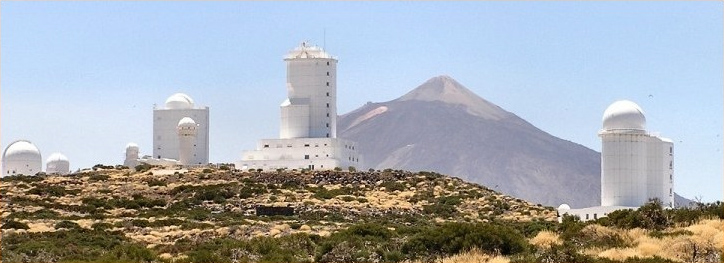
A Canary Islands cosmic ray counter
High on the volcanic slopes of Tenerife, at an altitude of 2,390 meters (7,840 feet), the Teide Observatory is one of the world's leading astronomical sites. While its large solar and nocturnal telescopes look outwards, another set of instruments points down, detecting the faint patter of particles from deep space. This is the Izaña Cosmic Ray Observatory (ICaRO), a facility designed to count the remnants of cosmic rays that have smashed into Earth's upper atmosphere.
ICaRO was installed in February 2023 through a collaboration between the University of Alcalá and the Izaña Atmospheric Research Center. Its location is strategic. The high altitude means there is less atmosphere to absorb the secondary particles created by cosmic ray impacts, and its position on the globe fills a gap in the worldwide Neutron Monitor Database (NMDB), a network of about 50 similar stations. The observatory has a vertical rigidity cutoff of 11.5 GV, meaning only primary cosmic rays with at least that much magnetic rigidity can generate secondary particles detectable at the site. This energy threshold makes the station useful for studying high-energy solar events and long-term variations in galactic cosmic rays.
The solar connection and the neutron monitor
The primary instrument at ICaRO is a 3NM64 neutron monitor. This standardized detector, first designed for the International Quiet Sun Year of 1964, doesn't detect cosmic rays directly. Instead, it measures secondary neutrons. When a high-energy cosmic ray—typically a proton from a supernova traveling near the speed of light—strikes an atom in the upper atmosphere, it creates a cascade of secondary particles, including neutrons, that shower down to the surface.
The NM64 monitor uses gas-filled proportional counters (containing Boron Trifluoride, BF3) surrounded by lead, polyethylene, and a wood casing. Fast secondary neutrons from the atmospheric cascade strike the lead producer, creating multiple lower-energy neutrons. These are slowed down by a polyethylene moderator, and a small fraction are finally detected by the BF3 counters. This design amplifies the original signal, providing statistically accurate measurements of the incoming cosmic ray flux.
Data from this monitor shows an inverse relationship with the Sun's 11-year activity cycle. During a solar maximum, the Sun's magnetic field and solar wind are strong, forming a protective bubble around the solar system that deflects more incoming galactic cosmic rays. As the Sun quiets to a solar minimum, this shield weakens, and the cosmic ray count at Teide can increase by about 20%. By continuously monitoring this flux, scientists can study the heliosphere's structure and the "space weather" that affects Earth.